Plasma “Fireballs” at CERN May Explain the Universe’s Missing Light
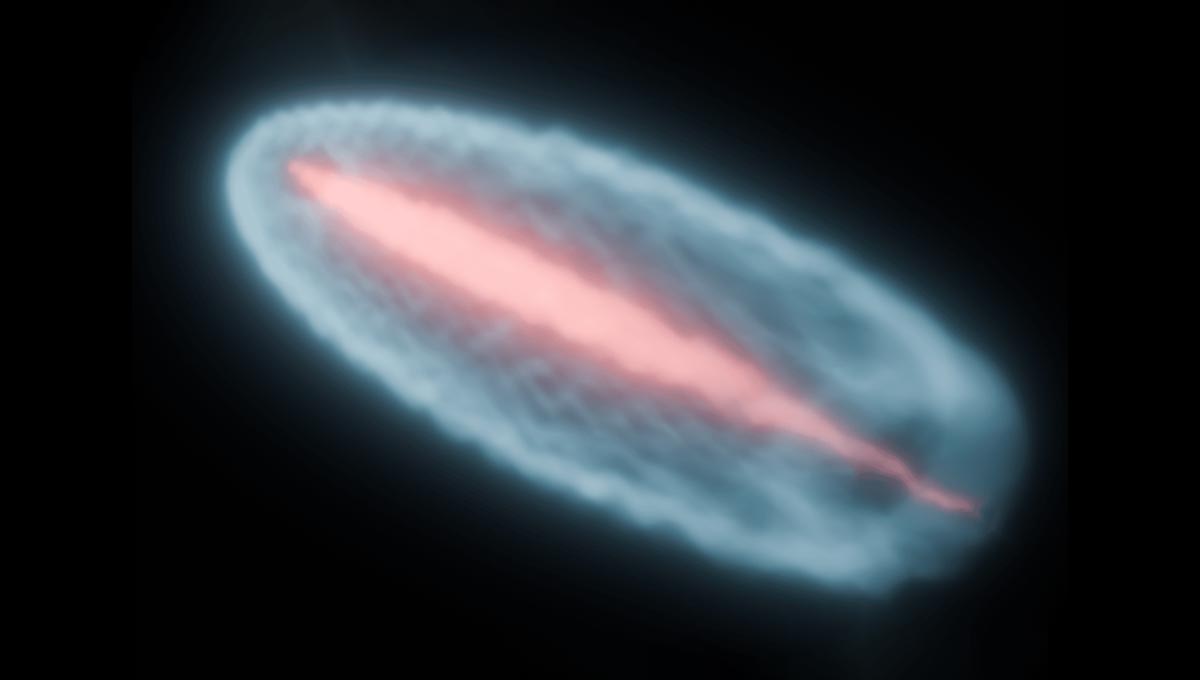
Simulation of an initially uniform beam of electrons & positrons interacting with a plasma. As the beam travels through the background plasma, the positrons (red) become focused while the electrons (blue) spread out to form a surrounding cloud. This illustrates the physics behind ‘current filamentation instability’, which is believed to play a key role in the propagation and dynamics of cosmic jets. The simulation was performed with the OSIRIS Particle-in-Cell code and is among the largest ever carried out for such beam-plasma interactions. Credit: Pablo J. Bilbao & Luís O. Silva (GoLP, Instituto Superior Tecnico, Lisbon & University of Oxford) The Fireball experiment installed in the HiRadMat irradiation area. Credit: Gianluca Gregori The team in the CERN Control Centre operating the Fireball experiment. Credit: Subir Sarkar Lab-made cosmic fireballs point to ancient magnetic fields shaping the Universe’s missing light. A global team of scientists led by the University of Oxford has accomplished a world first by producing plasma “fireballs” in a laboratory setting. Using CERN’s Super Proton Synchrotron accelerator in Geneva, the researchers set out to examine how plasma jets from blazars behave as they travel through space. Their findings, published in PNAS , offer fresh insight into one of astronomy’s long-standing puzzles involving missing gamma rays and the Universe’s elusive magnetic fields. Blazars and Extreme Gamma-Ray Emission Blazars are highly active galaxies fueled by supermassive black holes at their centers. These black holes eject narrow beams of particles and radiation that move at nearly the speed of light and, in some cases, point directly toward Earth. The jets release enormous amounts of gamma radiation, reaching energies of several teraelectronvolts (1 TeV = 10 12 /a trillion eV), which are observed using ground-based telescopes. As these high-energy gamma rays pass through intergalactic space, they collide with faint starlight in the background. This interaction creates cascades of electron-positron pairs. Scientists expect these particles to interact with the cosmic microwave background and produce lower-energy gamma rays in the GeV range (GeV = 10 9 eV). Yet gamma-ray space observatories such as the Fermi satellite have failed to detect this expected signal. Until now, the cause of this discrepancy has remained unclear. Two Competing Explanations One possible explanation is that weak magnetic fields spread between galaxies deflect the electron-positron pairs, sending the resulting gamma rays in directions that miss Earth entirely. Another idea comes from plasma physics. According to this hypothesis, the particle beams become unstable as they move through the extremely thin matter found in intergalactic space. Small disturbances within the beam could generate electric currents and magnetic fields that amplify the instability and drain energy from the jet. Simulating Blazar Conditions at CERN To determine which explanation is more likely, the researchers carried out an experiment at CERN’s HiRadMat (High-Radiation to Materials) facility. The project was a collaboration between the University of Oxford and the Science and Technology Facilities Council’s (STFC) Central Laser Facility (CLF). Using the Super Proton Synchrotron, the team created beams of electron-positron pairs and passed them through...
Preview: ~500 words
Continue reading at Scitechdaily
Read Full Article