Palestinian reporters have paid a terrible price in another horrific year for journalist killings | Jane Martinson
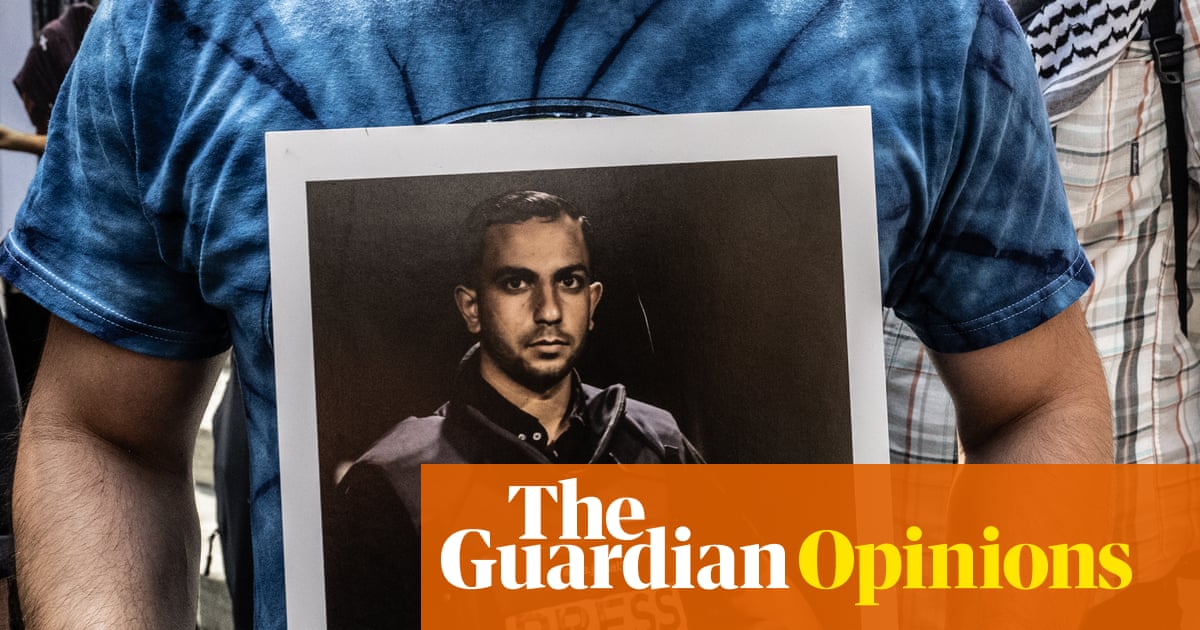
In January this year, Anas al-Sharif was filmed being lifted into the air after taking off his helmet and flak jacket to celebrate a ceasefire that would prove all too temporary in Gaza. This summer, the Palestinian journalist broke down while reporting on starvation in his home town that is now a war zone. A bystander told him : “Persist, Anas, you are our voice”. A protester holds a photo of Al Jazeera journalist Anas al-Sharif during a march in New York, 16 August 2025.Photograph: Stephanie Keith/Getty Images But al-Sharif’s popularity in Gaza made him a target. In July, international agencies warned of the danger he was in as the Israel Defense Forces stepped up online attacks, falsely labelling him a Hamas terrorist. His employer, Al Jazeera, insisted he restrict his reporting to the more protected al-Shifa hospital after his father and many colleagues were killed. In August, a few months short of his 29th birthday, al-Sharif and six others were killed in a direct attack on a media tent next to the hospital. In a posthumous post he said: “If these words reach you, know that Israel has succeeded in killing me and silencing my voice.” Anas al-Sharif is just one of 67 media professionals who were killed in 2025 while doing their jobs, identified by press freedom advocates Reporters Without Borders (RSF) in its annual report on journalists’ safety . The International Federation of Journalists (IFJ) goes even further - they found 111 journalists have been killed in 2025, nearly half in Gaza. Each one of these deaths is a tragedy, an abuse of the right of journalists to bear witness. Yet it is worth remembering the story of al-Sharif, not least because he became one of the highest profile examples of the tactic of discrediting journalists by accusing them of bias. The Israeli military confirmed that it targeted al-Sharif, claiming he led a Hamas terrorist cell and was “responsible for advancing rocket attacks against Israeli civilians” - somehow doing all of that while spending so much time on air. He had denied these accusations many times and none of the main press freedom advocacy groups - the Committee to Protect Journalists (CPJ), IFJ and RSF, nor the UN special agencies - have found any evidence that the allegations were true. Irene Khan, the UN special rapporteur for freedom of opinion and expression , said: “On the one hand, Israel refuses to allow any international journalists to enter Gaza, and on the other, it ruthlessly smears, threatens, obstructs, targets and kills the few local journalists remaining as the only eyes of the outside world on the ongoing genocide.” In August 2024, the CPJ called on Israel to stop making unsubstantiated terrorism allegations to justify its killing and mistreatment of Palestinian journalists. Fiona O’Brien, UK director of RSF, told me the young journalist’s story was a “very strong example of the way the Israelis are trying to discredit journalists without producing any credible evidence. It’s a very deliberate tactic.”...
Preview: ~500 words
Continue reading at Theguardian
Read Full Article