From bone damage to solar radiation - inside the lab trying to protect the astronauts of the future
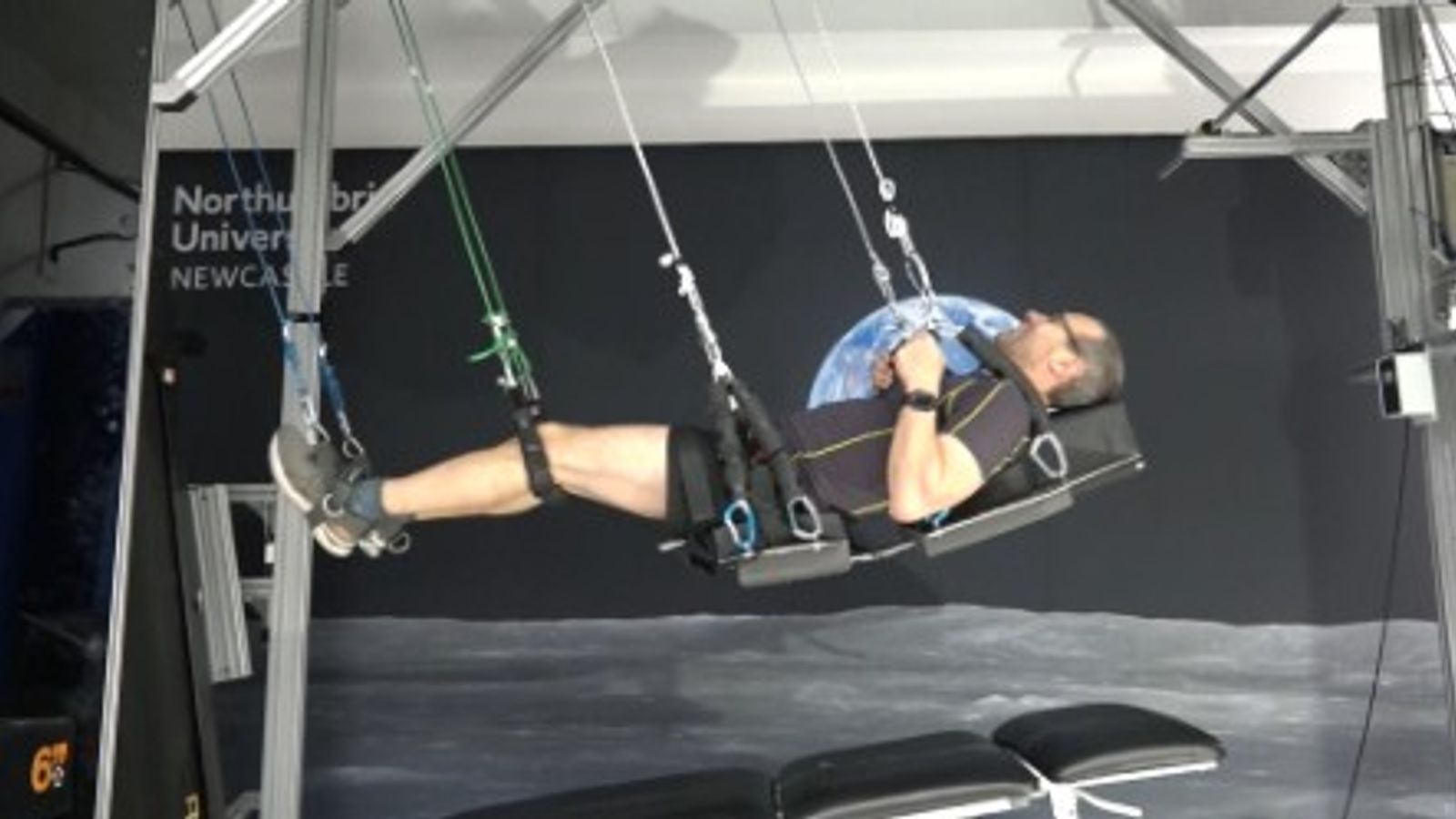
From bone damage to solar radiation - inside the lab trying to protect the astronauts of the future There are huge gaps in our knowledge of how to survive space. A lab in north east England is trying to change that. Image:The International Space Station seen from a docking craft. Pic: NASA Image:Tim Peake was the first British ESA astronaut to visit the International Space Station. Pic: Reuters Image:Professor Nick Caplan is the head of the University of Northumbria's aerospace medicine laboratory Image:2kg, sounds easy? Not when you have an inflatable cuff wrapped around your arm Image:NASA's next-generation moon rocket which will be used in the Artemis II mission. Pic: Reuters Image:Buzz Aldrin, lunar module pilot for Apollo 11, poses for a photograph beside the deployed US flag in 1969. Pic: Reuters Friday 26 December 2025 02:01, UK Space is an alien environment for humans. Our bodies are built for gravity; take it away and there are profound changes to our biology. Muscles and bones that keep us upright on Earth become weak. Body fluid that's normally pooled in our legs floods into our upper body, changing the shape of the heart and damaging the eyes. And genes that are inactive on Earth suddenly switch on. Others go silent. These are some of the lessons learned from 25 years of studying astronauts living and working on the International Space Station (ISS) . And they are challenges that scientists must do their best to overcome as humans embark on a new era of space exploration, venturing beyond the relative safety of Earth's orbit for the first time in more than half a century. Overcoming the bodily challenges of space Four astronauts will launch on a test flight around the moon within weeks. They will pave the way for future missions that will land on the surface and ultimately build a long-term presence, searching for ice and minerals. British astronaut Tim Peake knows all about the rigours of microgravity. He spent 186 days in orbit. "Effectively, you're taking relatively fit, healthy individuals and you're putting them through a 20-year aging process in a period of about two months," he told me. "Then you're watching that reverse when they come back to Earth again." The University of Northumbria has an aerospace medicine laboratory, where scientists are trying to find ways of helping humans adapt to space travel. In one corner there is a scaffolding rig - what the team calls a "variable gravity suspension system". Once attached to its strings, you dangle like a puppet, lying almost horizontally with feet resting on a treadmill that's fixed in an upright position, as if on a wall. And it is the closest thing on Earth there is to walking on the moon. You immediately realised why astronauts in those old Apollo-era movies bounce or lope across the lunar surface. The moon's gravity is one-sixth of the Earth's and if feels natural to take giant strides. It's exhilarating. The scientists use the suspension system to study...
Preview: ~500 words
Continue reading at Sky
Read Full Article