Fixed-Wing Runway Design
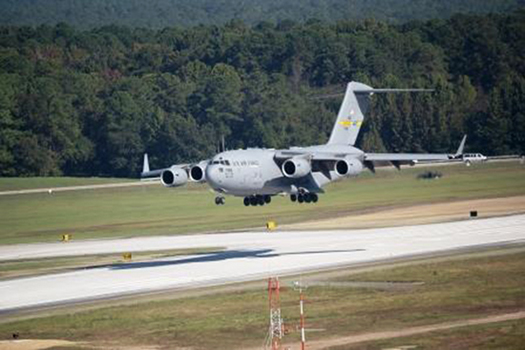
Overview Within This Page Runways are the primary operating surface at airfields and essential to fixed-wing aircraft operations. Fixed-wing runways are built in a variety of lengths, widths, and pavement types depending on a large number of factors, including: Aircraft Type (Operating Characteristics, Wingspan, Weight) Mission Number of Operations C-17 touchdown on runway Source: Defense Visual Information Distribution Service The primary reference describing requirements for DoD Fixed Wing Runways is Chapter 3 of UFC 3-260-01, Airfield and Heliport Planning and Design . Other special use runways (Landing Zones, STOVL Facilities and UAS runways) are defined in Chapters 7, 8 and 9 of the UFC. Typical airport diagram (View enlarged diagram) Source: Federal Aviation Administration Each DoD Service classifies fixed-wing runways into two primary categories-Class A or Class B-depending primarily on the type(s) of aircraft using the runway. That classification drives many required construction features of the runway, including length, width, transverse slopes, and longitudinal grades. It should be noted that civilian runways are classified by a very different system, defined in Federal Aviation Administration Advisory Circular 150/5300-13, Airport Design , with a classification system based on the critical aircraft's wingspan and landing approach speed. Fixed-wing runways are usually constructed with a rigid pavement surface (Portland cement concrete) or flexible pavement surface (asphalt cement concrete), but in special cases may be surfaced with compacted soil, aggregates, or segmented aluminum mats, depending on the mission requirements. Taxiways are used by aircraft to enter and exit a runway and transit to an aircraft parking position. Taxiways connect directly to runways, most often at the runway ends. In addition to the runway pavement surface, there are many ground surface areas immediately surrounding the runway that improve safety for the operating aircraft by limiting the risk of damage should an aircraft accidentally depart from the runway surface. Not only must objects be restricted from close proximity to the runway surface, the airspace surrounding a runway must also be protected from development that encroaches on the airspace needed for safe aircraft operations. The protected areas are defined by what are known as "imaginary surfaces." These are generally planar or conical surfaces in the air, defined by a length, width, and slope up to a specified elevation. Runway Design There are many different factors that impact runway design and are dependent on many different data inputs. All components should be determined early in the planning process to avoid unexpected challenges or constraints later in the design development. Runway Heading Runways are oriented to provide the best conditions for an aircraft on takeoff and landing. An aircraft moving directly into the wind has the highest airspeed across the wing, thereby increasing lift, and the least sideways forces on the aircraft. Therefore, the ideal orientation of the runway (often referred to as the heading ) is determined by analyzing historical wind data (10 years or more) at a location. Wind heading and speed data is graphically displayed on a Wind Rose , and this tool can be used to...
Preview: ~500 words
Continue reading at Hacker News
Read Full Article