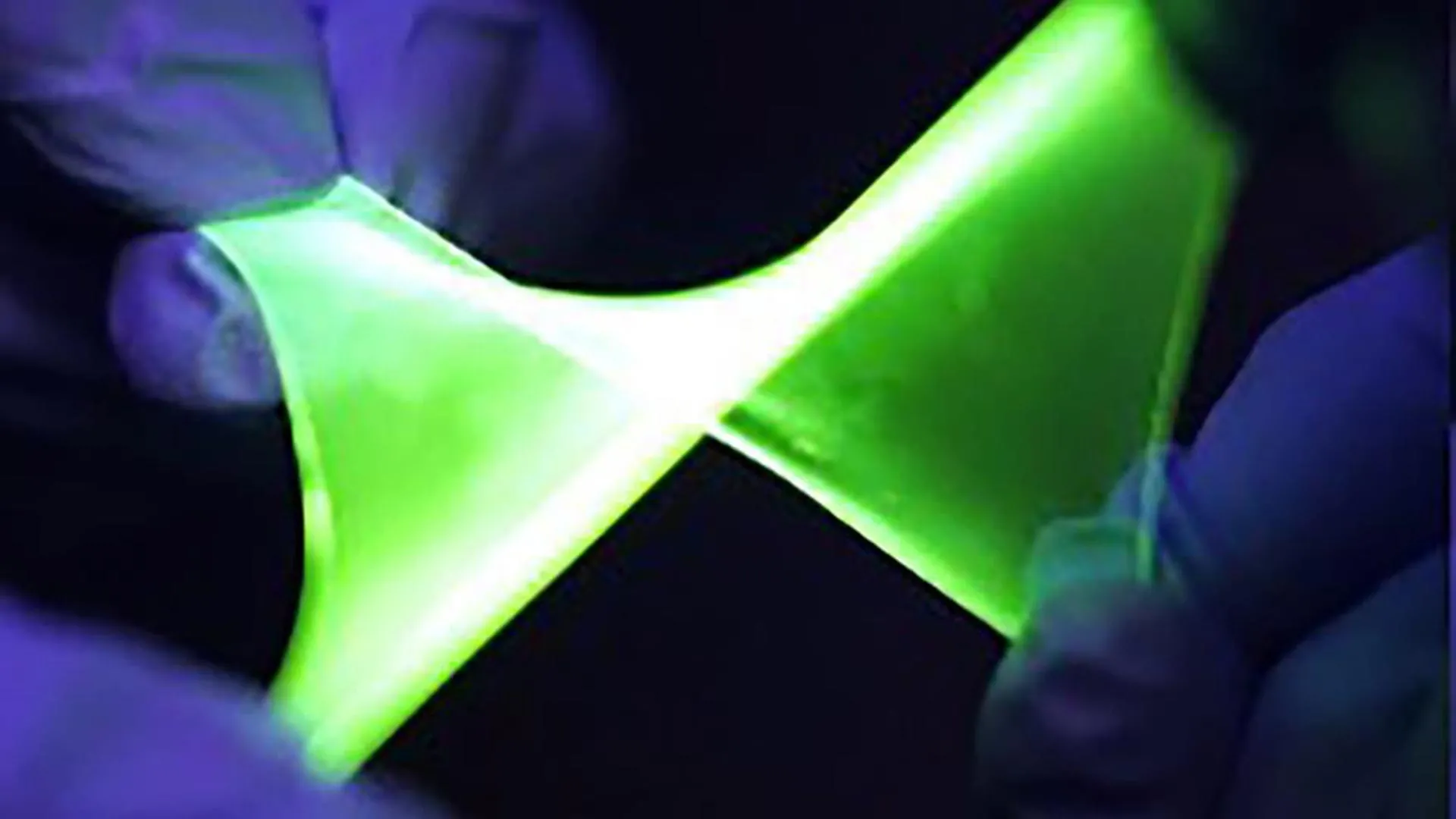
Stretchable OLED displays take a big leap forward
Stretchable OLED displays take a big leap forward Date: January 15, 2026 Source: Drexel University Summary: A new OLED design can stretch dramatically while staying bright, solving a problem that has long limited flexible displays. The breakthrough comes from pairing a highly efficient light-emitting material with tough, transparent MXene-based electrodes. Tests showed the display kept most of its brightness even after repeated stretching. The technology could power future wearable screens and on-skin health sensors. Share: The OLED technology found in flexible smartphones, curved computer monitors, and modern televisions may eventually be used in wearable devices that sit directly on the skin. These future systems could display real-time information such as changes in temperature, blood flow, or pressure. An international research team led by scientists from Seoul National University in the Republic of Korea and Drexel University has now developed a flexible and stretchable OLED that could move this idea closer to real-world use and unlock new applications. The research, recently published in Nature , introduces a redesigned OLED that combines a flexible phosphorescent polymer layer with transparent electrodes made from MXene nanomaterial. This approach allows the display to stretch up to 1.6 times its original length while retaining most of its brightness. "This study addresses a longstanding challenge in flexible OLED technology, namely, the durability of its luminescence after repeated mechanical flexion," said Yury Gogotsi, PhD, Distinguished University and Bach professor in Drexel's College of Engineering. "While the advances creating flexible light-emitting diodes have been substantial, progress has leveled off in the last decade due to limitations introduced by the transparent conductor layer, limiting their stretchability." Why OLEDs Lose Performance When Bent OLEDs generate light through a process known as electroluminescence. When electricity flows through the device, positive and negative charges move between electrodes and pass through an organic polymer layer. When these charges meet, they release light and form a particle called an exciton before settling into a stable electrical state. Adjusting the chemical composition of the organic layer determines the color of the emitted light. Flexible OLEDs are made by depositing these layers onto bendable plastic substrates, allowing them to function while folded, bent, or rolled. The technology was first developed in the 1990s and became widely visible in the 2010s when Samsung incorporated flexible displays into shatter-resistant devices and curved-edge phones. Over time, however, it became clear that repeated bending caused OLED brightness and flexibility to decline due to gradual damage in the electrodes and organic materials. "Imparting conducting materials with flexibility usually involves incorporating an insulating but stretchable polymer that hinders charge transport and, as a result, reduces light emission," said Danzhen Zhang, PhD, a co-author and postdoctoral researcher at Northeastern University, who conducted early work on transparent conductive MXene films as a PhD student in Gogotsi's lab at Drexel. "In addition, the material most commonly used in electrodes can become brittle and more likely to break the longer the OLED is flexed and stretched. This issue was addressed by using MXene-contact stretchable electrodes, which feature...
Preview: ~500 words
Continue reading at Sciencedaily
Read Full Article