‘Warning to others’: murky death of militia leader as Kremlin reasserts control
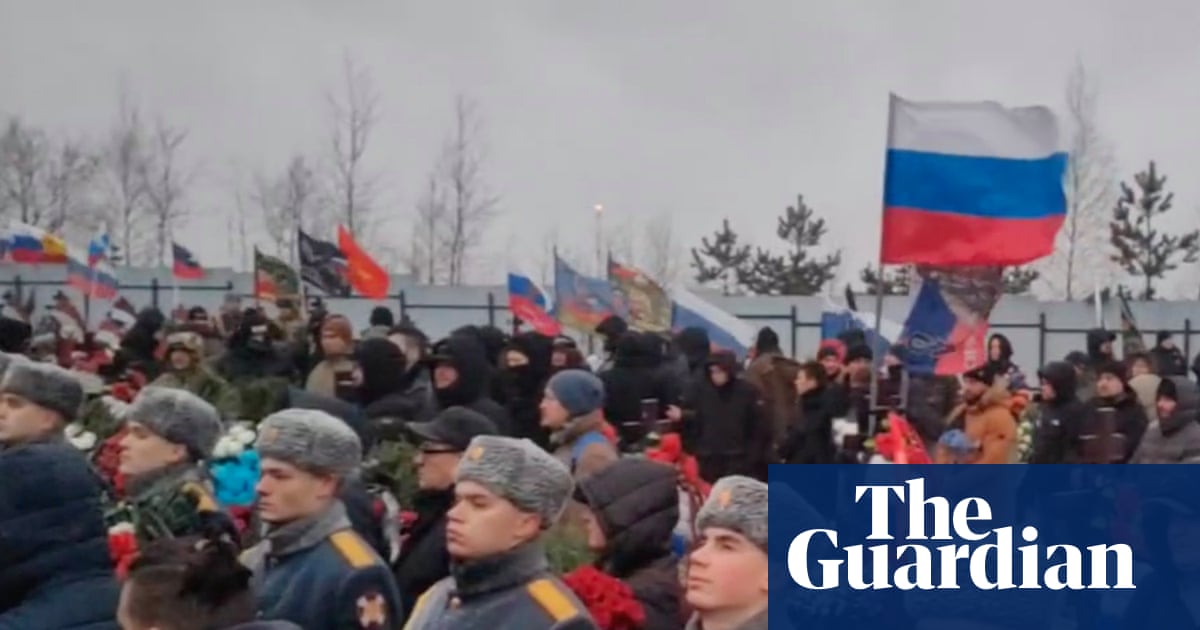
Beneath the frescoed ceilings and golden icons of Moscow’s Cathedral of Christ the Saviour, hundreds of men packed tightly into the lower hall as priests intoned prayers for the dead. Dressed in dark winter jackets, the mourners on Monday filled one of Russia’s most sacred spaces - a church usually reserved for moments of state ritual and national commemoration. Later, near his grave, the crowd lit bright flares and shouted: “One for all, and all for one.” The funeral of Stanislav Orlov, the leader of a far-right Russian militia unit called Española.Photograph: Telegram Stanislav Orlov led Russia’s far-right Española unit, which recruited football hooligans.Photograph: Social media/east2west news Mourners attend Moscow’s Cathedral of Christ the Saviour for Orlov’s funeral.Photograph: Telegram Former footballer Andrei Solomatin (left) with Orlov.Photograph: Telegram The grave of the Wagner group leader, Yevgeny Prigozhin, is located in Porokhovskoe cemetery on the edge of St Petersburg.Photograph: Anadolu Agency/Getty Images They had gathered to bid farewell to Stanislav Orlov, better known by his callsign “Spaniard”, the founder of the far-right Española unit - a formation of football hooligans and neo-Nazi volunteers who fought as a paramilitary force on Russia’s side in Ukraine . Russian pro-war Telegram channels framed the funeral as an act of consecration: a battlefield commander laid to rest at the heart of Moscow’s spiritual and political establishment. Yet amid the solemnity, one detail was conspicuously absent. No official cause of death was mentioned - a silence that only underscored the unease surrounding Orlov’s final days. For more than two weeks, Orlov’s death, first rumoured online on 9 December, was the subject of intense speculation and debate. Kremlin-linked Russian news websites and independent outlets soon reported that Orlov was not killed on the battlefield in Ukraine, but was ambushed and shot at his home in Russian-annexed Crimea by Moscow’s own security services. On Monday, Astra, an anti-war outlet operating in exile, published CCTV footage that it said showed the moments before Orlov was killed, with a group of armed Russian servicemen arriving outside his house, followed by the sound of gunshots. Astra reported that an ambulance only arrived to collect Orlov’s body six hours later. Analysts say Orlov’s death reflects a broader, increasingly visible crackdown by the Kremlin on renegade ultranationalist figures and semi-autonomous armed groups as a result of the Wagner mutiny . For much of Vladimir Putin’s full-scale invasion, the Russian state tolerated - and at times encouraged - radical formations that could mobilise fighters quickly and project uncompromising zeal. Units such as Española were useful militarily and ideologically, embodying a raw, street-level patriotism that complemented official propaganda. Española - which has been sanctioned by the UK and the EU - took part in some of Russia’s bloodiest assaults on Ukrainian cities, including the battles for Mariupol and Bakhmut . But it also served its purpose away from the frontlines. Española, which brought together football hooligans from Russia’s biggest football clubs, ran a particularly effective publicity campaign and managed to intersect with Russian sports culture and...
Preview: ~500 words
Continue reading at Theguardian
Read Full Article