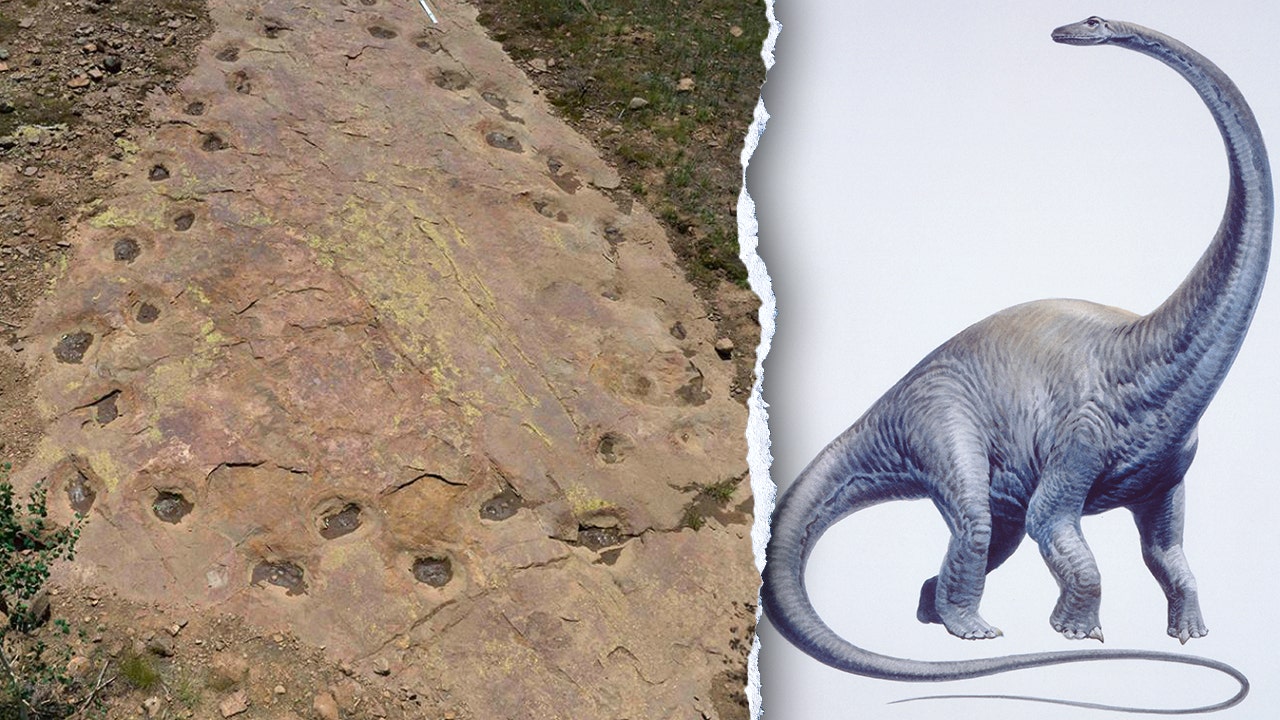
Limping dinosaur's twisted path puzzles paleontologists, 150 million years later: 'Very rare'
Ancient Hawaiian petroglyphs reappear on Oahu beach after shifting tides Seasonal tides and ocean swells have uncovered ancient Hawaiian petroglyphs on Oahu, exposing over two dozen human-like carvings last seen years ago. Paleontologists may have uncovered the traces of a dinosaur that may have been limping, thanks to fossilized footprints preserved in stone for over 150 million years. In a Nov. 25 press release from the University of Queensland (UQ), Australian officials announced that the discovery was made at an ancient trackway near Ouray, Colorado. Measuring over 310 feet long, the trackway consists of around 130 footprints. The dinosaur that made the track was likely four-legged and long-necked, belonging to the sauropod clade. SHOPPERS AT POPULAR MARKETPLACE WALKED OVER 'VILE' DUNGEON AS ARCHAEOLOGISTS CITE 'REMARKABLE' FINDS Speaking to Fox News Digital, UQ paleontologist Anthony Romilio said a long, looping dinosaur trackway like the Colorado one is "very rare." "Trackways that are turning are even rarer, " he said. "Trackways that loop - well, there are only two known in the world: the one in Colorado and one in China." A dinosaur's 150-million-year-old footprints show signs of a limp, according to Australian researchers. (Paul Murphey/San Diego Natural History Museum; De Agostini via Getty Images) "However, a rockslide has destroyed the one in China . So, that leaves this to be the only existing looping dinosaur trackway in the world." Though the exact species is unknown, Romilio said that Camarasaurus and Diplodocus are two dinosaur species that roamed Colorado at that time. "Camarasaurus was equivalent to being ‘front-wheel drive’, with its weight shifted more over the shoulders and front feet, and so there is a tendency to leave deeper handprints than footprints," he said. "Diplodocus, on the other hand, was equivalent to being ‘rear-wheel drive' with weight shifted over the hips, meaning its footprints are deeper than handprints." CLICK HERE TO SIGN UP FOR OUR LIFESTYLE NEWSLETTER Whether the dinosaur was limping because of a conflict with another dinosaur is also unknown, for now. "It is difficult to determine whether other dinosaurs were present at the time," said Romilio. The rare Colorado trackway offers an unusually long sequence of steps preserved in stone. (Paul Murphey/San Diego Natural History Museum) "As paleontologists, we work carefully within the bounds of the evidence, and in this case the information doesn’t yet indicate a confrontation or interaction with a nother dinosaur, " he added. "That said, the looping path is unusual...the idea that the trackmaker might have been avoiding something is certainly a compelling speculative interpretation." Footprints and trackways, Romilio noted, can only be made when an animal is alive - and the remnants can reveal how these ancient creatures walked and ran in ways that fossil bones can't. CLICK HERE FOR MORE LIFESTYLE STORIES "In terms of taking trackway measurements, long trackways like this one allow us the opportunity to even undertake statistical analyses," he noted. "By assessing the difference between the steps made with the left leg versus that from the right, we found...
Preview: ~500 words
Continue reading at Foxnews
Read Full Article