These Giant Long-Necked Dinosaurs Could Stand Upright – and Scientists Finally Figured Out Why
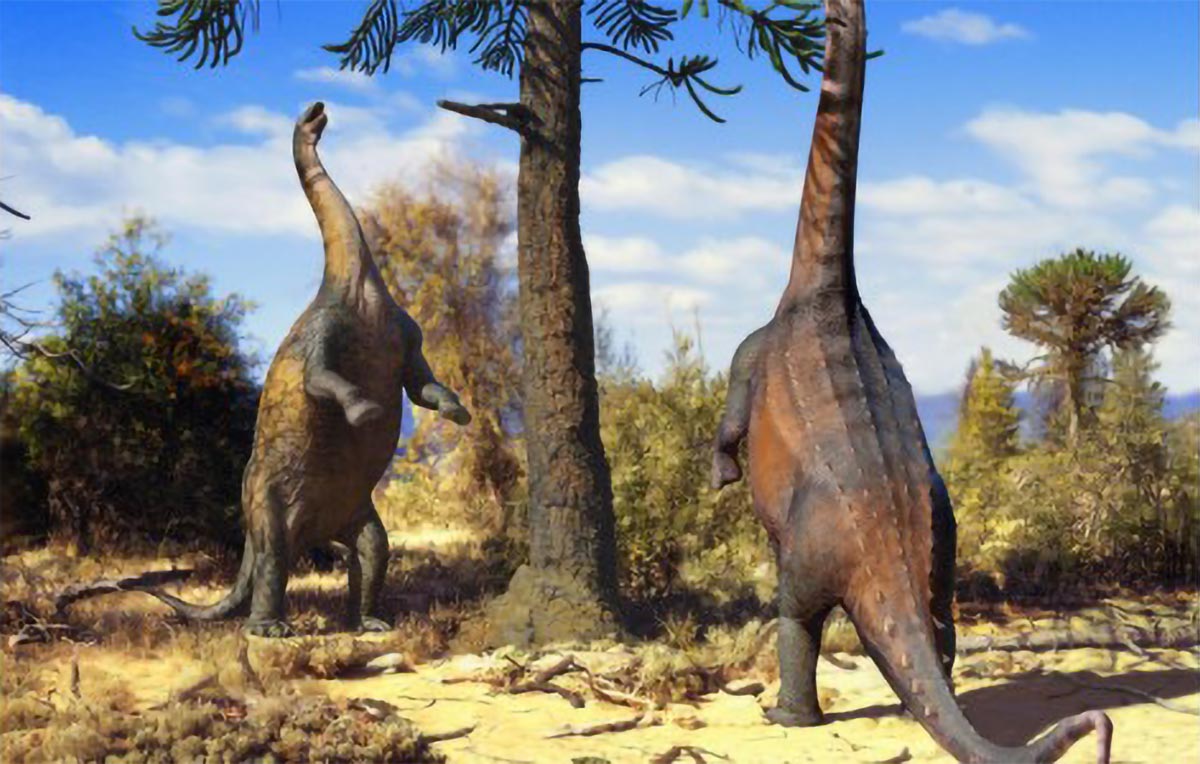
Two Neuquensaurus stand on their hind legs to reach the top of a tree. Computational analyses indicate that the species could easily remain in this position 66 million years ago. Credit: Guilherme Gehr By applying computational engineering methods to model weight and gravitational forces acting on sauropod femurs, researchers found that these massive four-legged dinosaurs were generally able to stay upright while feeding, mating, and defending themselves. Sixty-six million years ago, two types of long-necked, four-legged dinosaurs had an edge over other sauropods because they could readily rise up and remain standing on their hind legs for long stretches of time. This ability likely helped them deter predators and reach leaves growing high in trees, among other advantages. The Brazilian Uberabatitan and the Argentine Neuquensaurus were roughly comparable in size to a modern elephant. While they were relatively small members of the sauropod group, adult Uberabatitans are estimated to have grown as long as 26 meters, making them the largest dinosaurs known from Brazil. Because of their enormous size, these animals were probably only able to stay upright for extended periods when they were still young. This finding comes from a study supported by FAPESP and published in the journal Palaeontology . The research team included scientists from Brazil, Germany, and Argentina. Engineering tools test dinosaur strength To investigate how these dinosaurs supported their weight, the scientists relied on a computational approach commonly used in engineering. Their goal was to calculate the stress placed on the femur by gravity and body weight when the animals stood on their two hind legs. “Smaller sauropods like these had a bone and muscle structure that allowed them to stand more easily and for longer on their two hind legs. Larger ones were probably also able to stand, but for a shorter time and with less comfort, since the position caused a lot of stress on the femur,” summarizes Julian Silva Júnior, a postdoctoral researcher at the School of Engineering of São Paulo State University (FEIS-UNESP) in Ilha Solteira, Brazil. Silva Júnior is the first author of the study, which was conducted during an internship at the University of Tübingen in Germany with a scholarship from FAPESP. Digital bones reveal stress patterns The research team created digital reconstructions of the femurs from seven sauropod species that represented a range of evolutionary lineages, body sizes, and distinctive anatomical features. These virtual bones were built using fossil specimens housed in natural history museum collections around the world. The simulations relied on finite element analysis (FEA), a computational method used to predict how materials respond to forces and heat. This same technique is commonly applied in fields such as bridge engineering, for example. “Using this technique, we performed two simulations. One dealt with the extrinsic scenario, simulating the force coming from outside to inside. In this case, gravity and the animal’s own weight on the femur when the dinosaur was standing on its hind legs. In the other, we analyzed the intrinsic scenario, the force that the...
Preview: ~500 words
Continue reading at Scitechdaily
Read Full Article