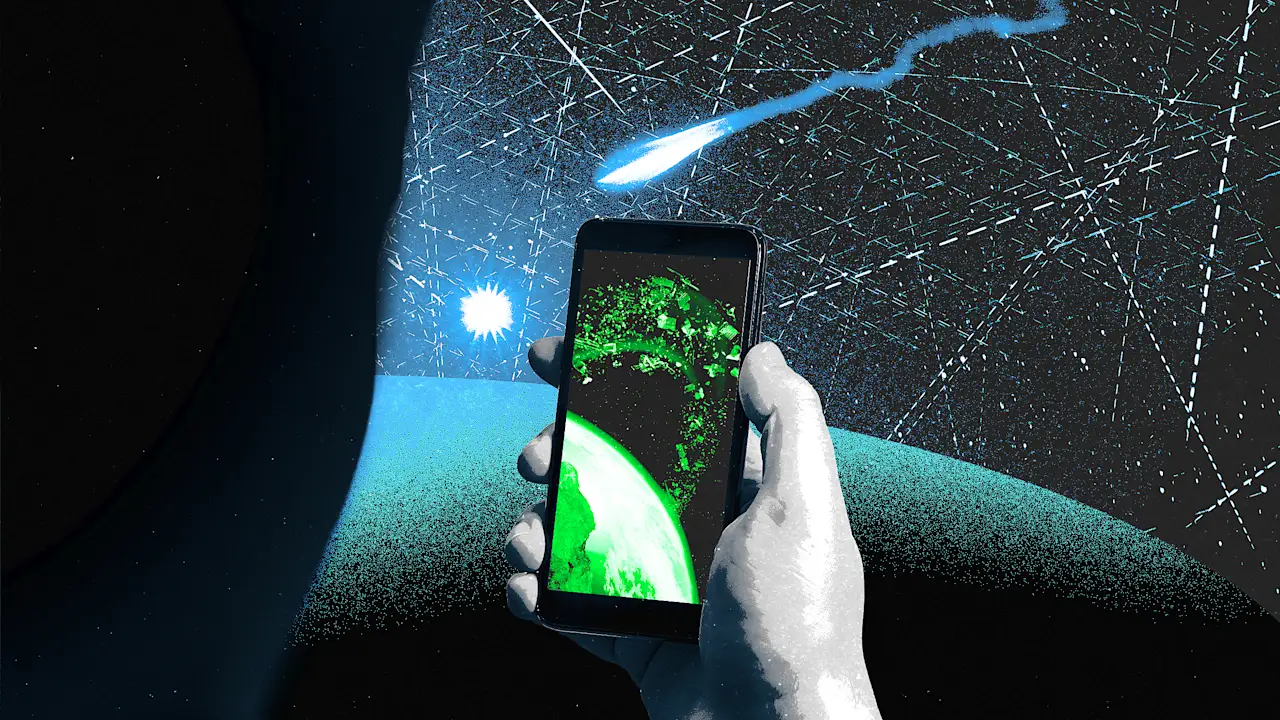
Is Elon Musk losing the space cellphone war?
The fiercest space race is not about getting back to the moon —it’s about allowing you to post a TikTok or watch Netflix on your phone anywhere around the globe, from the Atacama Salt Flats to the Khongor sand dunes in the Gobi Desert. To make this happen, two distinct design philosophies are at war, as companies build out the infrastructure needed to ensure every phone on the planet is permanently connected to the internet. On one side is Elon Musk’s SpaceX/Starlink and the copycat companies that have followed in Starlink’s wake. Their approach is to invade space with tens of thousands of small satellites, creating a network of objects that blanket low Earth orbit. On the other side is a small Texas-based company called AST SpaceMobile, which believes it can provide better service with fewer than 100 gigantic satellites in space. Both companies—along with Amazon and a handful of Chinese organizations—want to dominate worldwide wireless communications. The satellite constellation with the fastest service, widest coverage, best compatibility with 5G cellphones, and lowest operational costs will own how we communicate for years to come. Which approach prevails will have serious impact not only on the future of the internet but also the health of our planet. A new space race era Musk set off a new space race with his desire to rule low Earth orbit. SpaceX, which owns Starlink, launched its first satellite in 2019, providing broadband internet access to anyone with a large Starlink antenna and modem on the ground. Since then, it has put more than 9,000 satellites into orbit. The company projects it will eventually have a constellation of 34,000 satellites. After Starlink’s initial launch, competitors followed suit, including Jeff Bezos and his Project Kuiper—now called Amazon Leo—and the Chinese, whose plans include two large satellite constellations. But there’s a fundamental problem with this mega-constellation design: Musk’s plan for space internet is a flawed, wasteful, and dangerous game of orbital Russian roulette. The crowded sky, a 30-minute exposure taken in June 2025 [Photo: Alan Dyer/VWPics/Universal Images Group/Getty Images] Scientists worry that Starlink’s projected 34,000-satellite constellation will cause irreparable damage to the atmosphere . A large-scale constellation also dramatically increases the possibility of a space collision that could start a catastrophic chain reaction, destroying orbital networks that are crucial for our survival as a species. Jonathan McDowell, an astrophysicist and spaceflight historian at the Harvard-Smithsonian Center for Astrophysics, has been documenting satellite launches in his newsletter, Jonathan’s Space Report . He believes there may be other, better ways to achieve global coverage via satellites—if we need to be doing it at all. “I do personally have a preference for smaller numbers of larger satellites,” he tells Fast Company . “One of the reasons is the risk of space collisions. If you have 10 times as many satellites, you have 100 times as many close misses. So from that point of view alone, consolidating on a smaller number of satellites seems wiser.” A more efficient alternative That’s where...
Preview: ~500 words
Continue reading at Fastcompany
Read Full Article