In axolotls and flatworms, regeneration is a body-wide choreograph
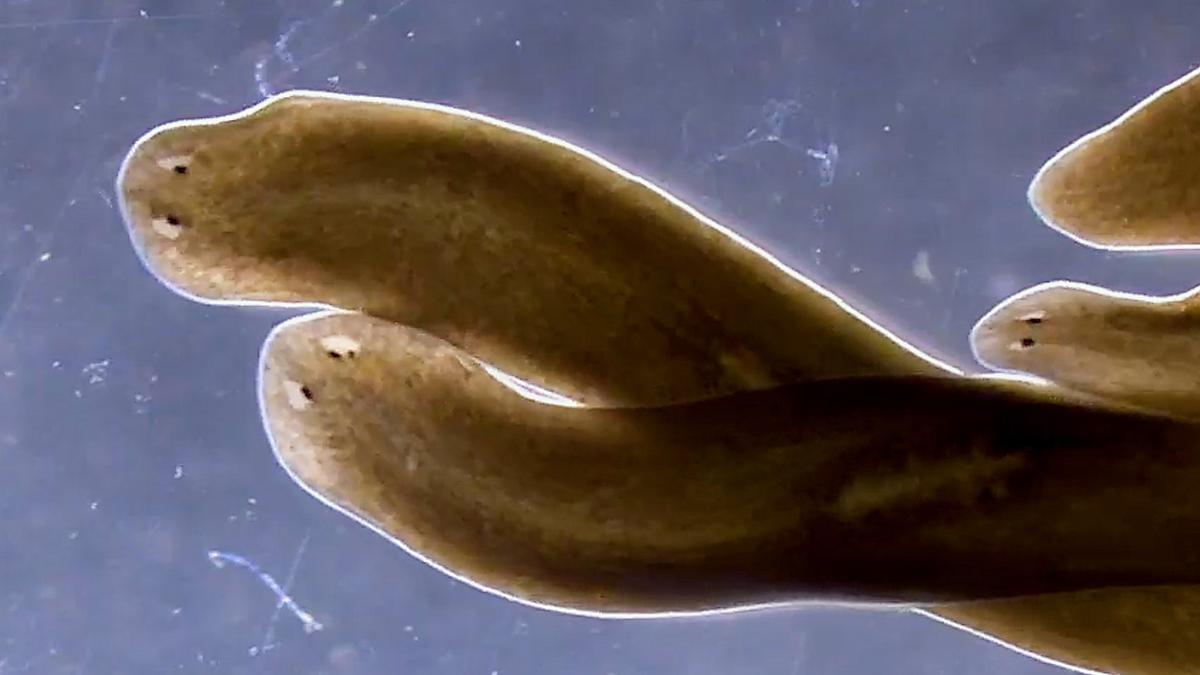
Planarian flatworms are small, unassuming creatures with an astonishing talent . Cut one into pieces, and each fragment can regrow a complete animal. This seemingly magical ability comes from their prolific stem cells, known as neoblasts, which can produce every tissue in the body. In most animals, such regenerative stem cells grow under the care of nearby niche cells, small micro-environments that signal when to divide. But planarians, despite their extraordinary powers of renewal, appear to lack any such neighbourhoods, leaving biologists puzzled about where their stem cells get their cues. In a new study in Cell Reports , researchers at the Stowers Institute for Medical Research in Missouri, USA, found that the missing niche might not be local at all, but comes from the gut. They combined a powerful gene-mapping tool called Slide-seqV2 with electron microscopy to chart where thousands of stem cells sit and which genes they switch on. The maps revealed that neoblasts rarely stay in contact with nearby tissues, yet their activity depends on chemical messages sent from the intestine. When key intestinal genes were turned off, the usual post-injury burst of cell division disappeared and regeneration faltered; even day-to-day cell replacement changed. “The planarian gut functions as a central regulator for whole-body regeneration,” the study’s corresponding author Alejandro Sánchez Alvarado, a molecular biologist at the Stowers Institute, said. He added that the same gut signals may also help guide routine tissue renewal across the body. The findings don’t put the intestine in charge. Instead, they point to a cooperative system in which many tissues, including the gut, help steer stem cells through shared chemical cues. Because stem and intestinal cells sit only a few micrometres apart (roughly a single cell’s width), their conversations are likely carried by molecules such as small proteins, fats or other metabolic signals rather than direct contact. That is to say, in planarians, regeneration seems to depend on a diffuse web of nearby chemical signals rather than a single, fixed neighborhood. A composite image of a planarian flatworm regrowing itself from a truncated form. | Photo Credit: Special arrangement Poised to heal In another species, that same kind of long-range communication runs through the nervous system rather than the gut. When an axolotl ( Ambystoma mexicanum ) loses a limb, the cells at the stump gather and multiply into a mound of tissue called the blastema, which becomes an engine of new growth. For decades, scientists believed this small structure contained a major part of the regenerative programme. But a new study in Cell by a group at the Harvard Stem Cell Institute in Massachusetts, USA, has reported that the body itself joins the act. After amputation, a burst of activity in the animal’s stress response nerves briefly drives cells throughout the body to reenter the cycle of division. This organism-wide systemic activation seems to prime the animal for repair. When a previously uninjured limb is later amputated, its blastema is noticeably larger by two weeks. The response was found to...
Preview: ~500 words
Continue reading at Thehindu
Read Full Article