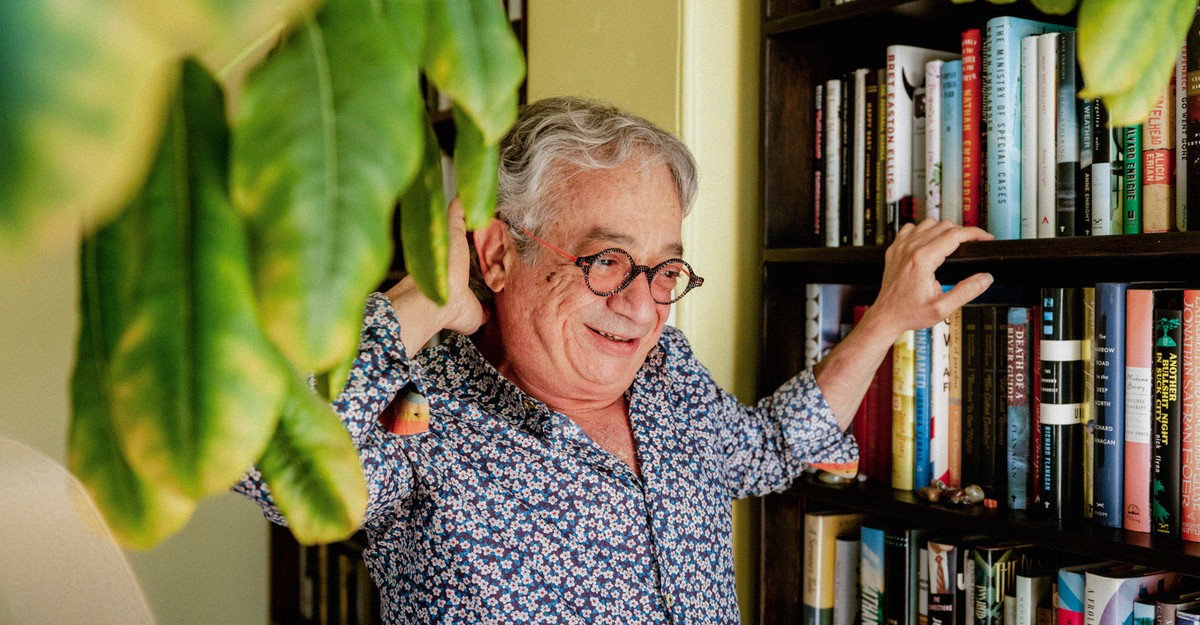
The Writer Fueled by Life’s Randomness
“W hen I’m told I should write a certain way, I bristle,” Rabih Alameddine wrote in a 2018 Harper’s essay . “I even attempt to write in opposition to the most recent book I finished. If my previous novel was expansive, I begin to write microscopically; if quiet, I write loudly. It is my nature.” The 66-year-old artist and novelist has, over the course of a nearly three-decade career, turned this urge, which he self-deprecatingly calls “childish rebelliousness,” into a varied and sophisticated body of work. His 1998 debut, Koolaids: The Art of War , juxtaposed the Lebanese Civil War and the AIDS epidemic—two tragedies that shaped the author’s early life—in a furious, fragmented tale, as if the book itself were shattered by its anger. Since then, Alameddine has continued to invent his own forms, but also drawn on more venerable ones: He’s written a novel made entirely of first chapters and another that uses camp to riff on the Thousand and One Nights ; his seventh and latest, the National Book Award–winning The True True Story of Raja the Gullible (And His Mother) , employs drag as a central metaphor that informs both its story and its layered structure. The only quality uniting his books, it can seem, is their literary fearlessness. For Alameddine, no storytelling challenge is too great. The True True Story Of Raja The Gullible (And His Mother) By Rabih Alameddine Buy Book And yet fear is among his recurring themes. Each of Alameddine’s books, dissimilar as they otherwise may be, is an attempt to wrestle with the terrifying arbitrariness of fate. This preoccupation seems to emerge from Alameddine’s personal understanding that the unpredictable swings of history can change a person thoroughly, irrevocably, and without warning. In “How to Bartend,” a wrenching yet humorous essay about living through the AIDS epidemic, Alameddine describes testing positive for HIV and his subsequent terror of getting sick, which did not happen. The piece concludes, “I did not die and I did not recover.” Sometimes his characters are frankly afraid of this fact; sometimes they treat it as a cosmic insult, a cruel joke, or, less often, a potential relief. No matter the emotions he’s channeling, though, Alameddine maintains a sense of levity, one perhaps born of his feeling that, as he told NPR earlier this year, our society is “too earnest.” How do we deal with terror, he went on, if we can’t “laugh about it?” His writing style, which is relentlessly playful, matches this belief. In 2016’s The Angel of History —perhaps Alameddine’s saddest novel—Jacob, a gay Yemeni poet living in San Francisco, conjures friends he’s lost to AIDS and rages at the homophobia they faced as they died; he wrestles with deep survivor’s guilt and despairs at the next generation’s lack of interest in the pandemic. Alameddine injects a spiky humor into Jacob’s shattering grief: In one scene, Jacob recalls exploding at a younger gay writer for his generation’s willingness to embrace straight culture in a monologue...
Preview: ~500 words
Continue reading at Theatlantic
Read Full Article