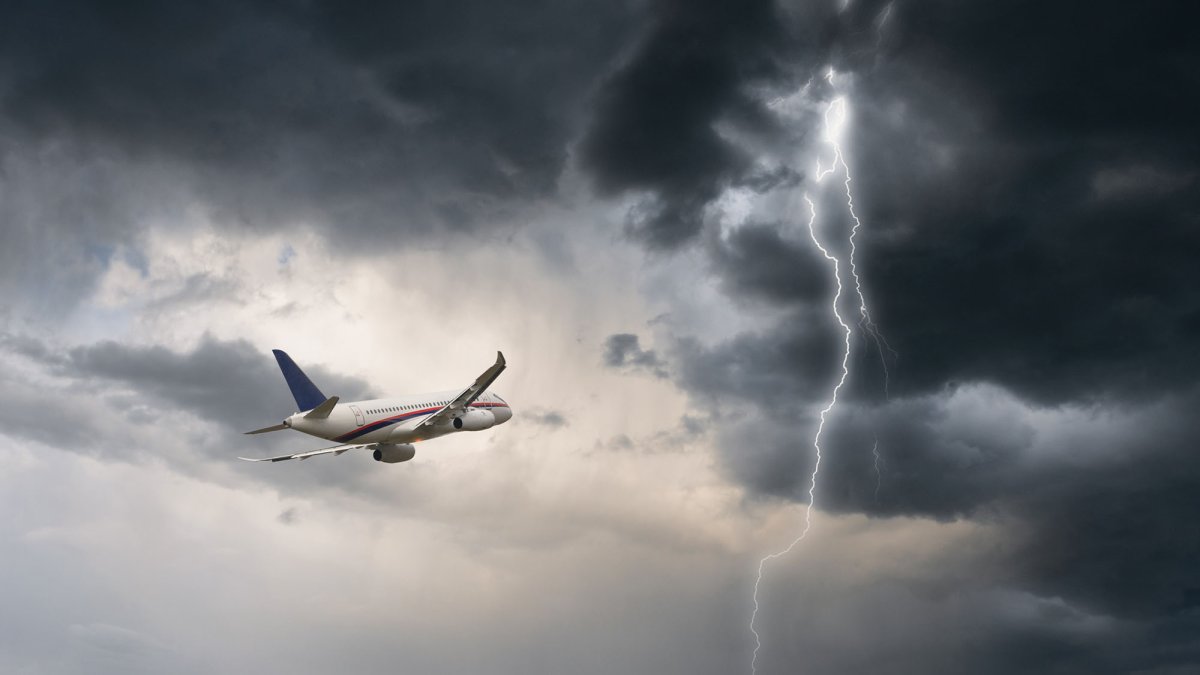
How pilots avoid thunderstorms—and what happens when they can’t
In the 2023 movie Plane starring Gerard Butler, a commercial aircraft is caught in a terrible storm. Dark purple thunderclouds suffocate the sky. The plane shakes and the lights go out. Turbulence throws an unbelted passenger across the cabin. Eventually a lightning strike cuts the plane’s power, forcing it to crash land in a warzone, where the movie’s story really begins. Advanced weather radars in planes show pilots what parts of a storm to avoid.Video: Amazing Lighting show – How MASSIVE thunderstorms look on airliner radar scope!/DIY with Michael Borders Planes are designed to withstand lightning strikes.Video: Lightning hits plane leaving BC airport/@globalnews In reality, plane crashes in thunderstorms are extremely rare-largely because pilots seldom fly into thunderstorms in the first place. “You’re never going to intentionally fly into a thunderstorm, because thunderstorms contain the roughest air, as well as other hazards,” says Patrick Smith, an airline captain and writer of the Ask the Pilot blog . How pilots track thunderstorms Avoiding thunderstorms, Smith explains, involves close collaboration between meteorologists, air traffic control, and the flight crew, both before and during the flight. “We receive reports and forecasts before every flight indicating where storms might occur,” he says, referring to detailed satellite mapping provided by meteorologists. “But if you’re on a 12-hour flight, the information you have at the beginning is only so valuable. What you’re really relying on are the real-time tools.” Part of the job of Smith and other pilots is to constantly monitor the plane’s onboard radar and Weather Avoidance System (WAS), which show “where storms are, how high they are, how fast they’re moving, the direction they’re moving and so on,” he says. “[The radar] sends a signal out from the airplane and it bounces off the water in the clouds and comes back,” former pilot Tom Bunn explains. “The more water, the more intense the thunderstorm.” Another key source of information comes from other pilots “There might be 20, 30, 40 airplanes that [air traffic] control is watching at a certain altitude range,” Bunn says. “Everybody’s on the same frequency, you can hear each other. If you have turbulence, you’re supposed to announce it.” This combination of radar and information-sharing allows pilots to track storms and rough air up to a couple of hundred miles ahead. They can then ask air traffic control for a change of altitude to avoid turbulence, or a change of route to bypass a storm. Most airlines recommend that pilots keep a minimum of 10 to 20 miles distance from thunderstorms, depending on their severity. “You see with your radar, it’s color-coded,” Bunn says. “The green is the edge of the thunderstorm, that’s bumpy, but it’s not severe. The yellow would be pretty severe and then there’s red. You just want to stay out of that.” Video: Amazing Lighting show - How MASSIVE thunderstorms look on airliner radar scope!/ DIY with Michael Borders How planes fly through storms When flying through scattered thunderstorms, pilots may sometimes choose to chart a...
Preview: ~500 words
Continue reading at Popsci
Read Full Article