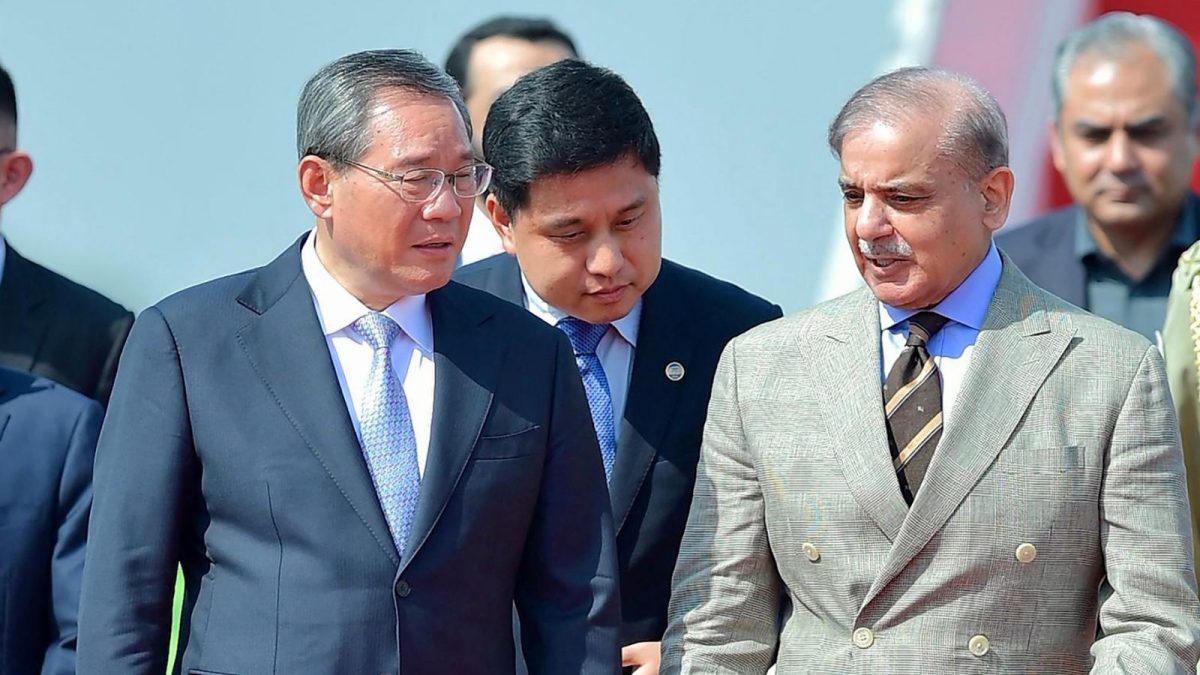
China Backed Pakistan With Intelligence, Info Warfare During Op Sindoor: US Report | Exclusive
China Backed Pakistan With Intelligence, Info Warfare During Op Sindoor: US Report | Exclusive According to the assessment, Pakistan executed the visible, kinetic and proxy elements of pressure during the operation, while China remained largely in the background. US Defence Department-linked assessments have shed new light on how China and Pakistan are recalibrating their approach towards India through coordinated “grey-zone" strategies - operations designed to apply sustained pressure without crossing the threshold of open war. The findings, accessed by CNN-News18, suggest that Operation Sindoor marked a significant test case of this evolving doctrine. According to the assessment, Pakistan executed the visible, kinetic and proxy elements of pressure during the operation, while China remained largely in the background, shaping the battlefield through information warfare, cyber activity, intelligence support, and diplomatic manoeuvring. Chinese satellite coverage and electronic surveillance inputs are believed to have enhanced Pakistan’s real-time situational awareness, improving targeting and operational coordination without direct PLA involvement. Recommended Stories A central feature of Beijing’s approach was plausible deniability. While Pakistan absorbed international scrutiny as the immediate actor, China focused on amplifying Pakistan’s narrative through controlled diplomatic messaging and calibrated online information campaigns. These efforts sought to blur attribution, question Indian claims, and slow the formation of any international consensus in India’s favour. US officials assess this as a deliberate attempt to test India’s escalation thresholds while keeping Chinese fingerprints indirect. The report underlines that China’s military planners increasingly view India as a core sovereignty and long-term strategic challenge, even though Beijing’s primary focus remains the US-Taiwan theatre. India, the assessment says, is being shaped as a future containment target - particularly across the Himalayan frontier and the Indian Ocean Region - where China seeks to constrain India’s strategic rise. Pakistan continues to play a pivotal role in this calculus. US intelligence sources describe Islamabad as China’s “pressure valve" against India - used to keep New Delhi strategically distracted, dilute expanding India - US defence cooperation, and experiment with hybrid warfare models at relatively low cost to Beijing. The coordination between Beijing and Islamabad is emerging as a key tool to apply multi-domain pressure without triggering full-scale conflict. Interestingly, the Pentagon also views China’s October 2024 disengagement agreement with India along the Line of Actual Control (LAC) as a calculated move. Rather than signalling reduced rivalry, US officials believe Beijing sought temporary stabilisation on its western periphery to prevent India from further accelerating defence alignment with Washington. Beyond South Asia, the Pentagon is tracking around 20 countries, including Pakistan, Sri Lanka, and Cuba, where China may be exploring future military basing or logistics access - an expansion that would have direct implications for India’s maritime and continental security environment. The assessment concludes with a clear warning: any future India-China conflict is likely to begin below the threshold of war. Cyber disruptions, economic coercion, information warfare, and proxy instability are expected to precede any kinetic escalation. Operation Sindoor, US officials believe, has already demonstrated how this model could be applied - signalling a more...
Preview: ~500 words
Continue reading at News18
Read Full Article