Inside Uranus and Neptune, Water Becomes Something Totally Unexpected
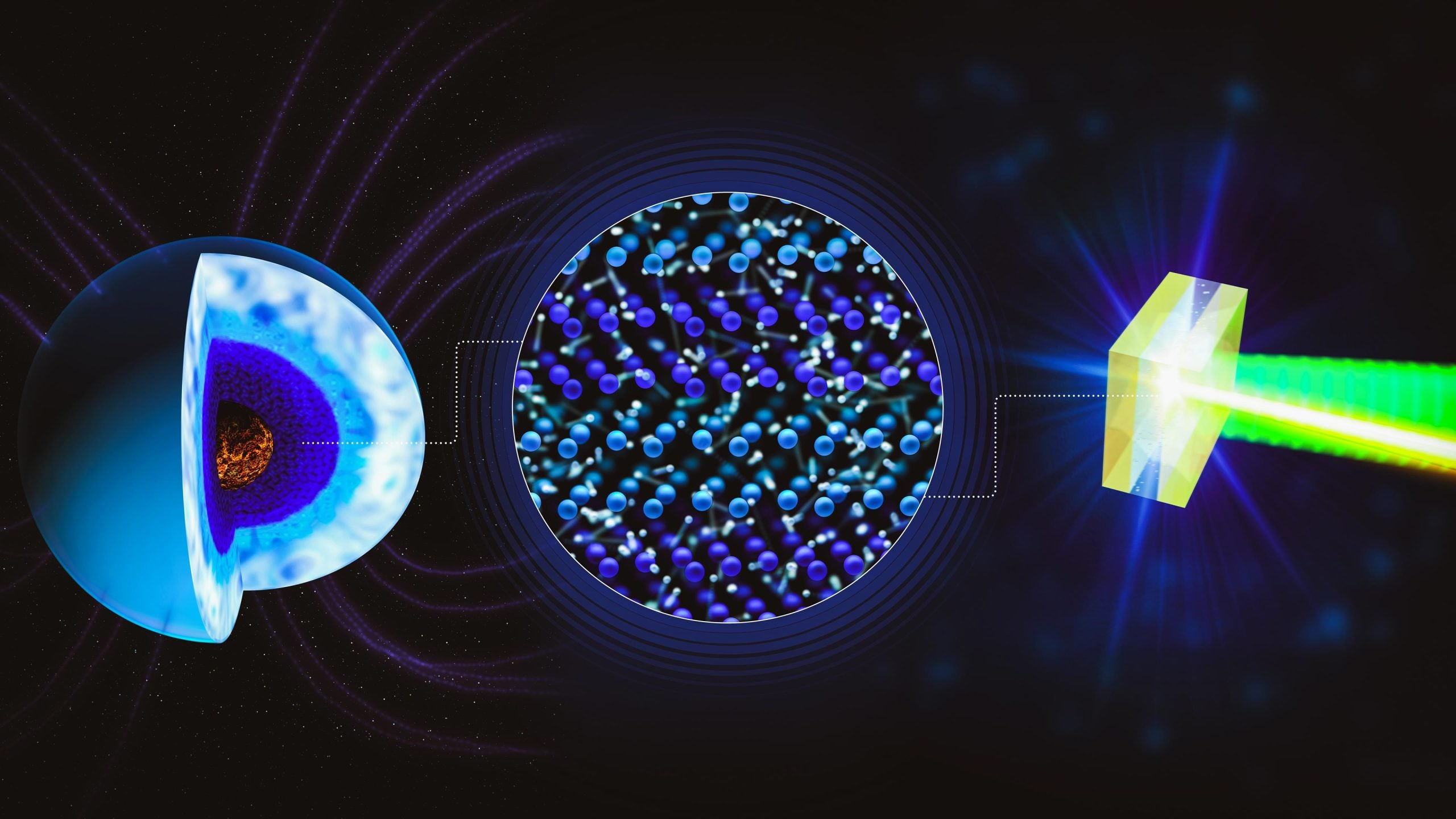
Schematic representation of the microscopic structure of superionic water, in which the oxygen atoms form a solid crystal lattice, while hydrogen ions are virtually free to move within it. With the aid of powerful lasers, this extreme state, which otherwise only occurs inside large planets, could be measured experimentally. Credit: Greg Stewart / SLAC National Accelerator Laboratory Under extreme planetary conditions, water turns into a strange, electricity-conducting solid hidden deep inside giant planets. Superionic water forms only under some of the most intense conditions found in nature, with temperatures reaching several thousand degrees Celsius and pressures climbing to millions of atmospheres. Under these extremes, water enters an unusual state where oxygen atoms lock into a solid framework while hydrogen ions move freely through the structure. Why Superionic Water Matters for Giant Planets Because this phase allows electrical current to flow so efficiently, scientists link it to the unusual magnetic fields observed around ice giant planets. Uranus and Neptune are believed to contain enormous amounts of water deep within their interiors, raising the possibility that superionic water may be the most widespread form of water in the solar system. A Longstanding Mystery About Atomic Structure Superionic water has been created in laboratory experiments before, but its internal arrangement remained uncertain. Earlier studies proposed that the oxygen atoms might organize themselves into one of two cubic structures. These included a body-centered cubic pattern, with an atom located at the center of each cube, or a face-centered cubic pattern, with atoms positioned on the cube’s faces. New Experiments Reveal a More Complicated Picture The latest research shows that the reality is far more complex. Instead of forming a single orderly pattern, superionic water contains a mix of face-centered cubic regions and hexagonal close-packed layers. In the hexagonal regions, atoms stack tightly in repeating six-sided patterns. When these different arrangements overlap, they produce widespread structural irregularities. Rather than a clean, repeating lattice, the oxygen atoms form a hybrid and disordered sequence that can only be detected using extremely precise measurements from advanced X-ray lasers. Recreating Planetary Conditions in the Laboratory To uncover these details, researchers carried out two major experiments. One took place at the Matter in Extreme Conditions (MEC) instrument at LCLS in the US, and the other was conducted at the HED-HIBEF instrument at European XFEL. These facilities allowed scientists to compress water beyond 1.5 million atmospheres and heat it to several thousand degrees Celsius, while capturing snapshots of its atomic structure within trillionths of a second. What This Discovery Reveals About Water and Planets The findings closely match results from the most advanced computer simulations and show that superionic water can adopt multiple structural forms. This behavior mirrors that of ordinary ice, which is known to exist in many crystal structures depending on temperature and pressure. The work highlights that water-despite its apparent simplicity-continues to exhibit surprising and complex behavior under extreme conditions. The results also provide important limits for improving models of the internal structure and evolution of ice giant...
Preview: ~500 words
Continue reading at Scitechdaily
Read Full Article