In the snow, these salamanders get supercool
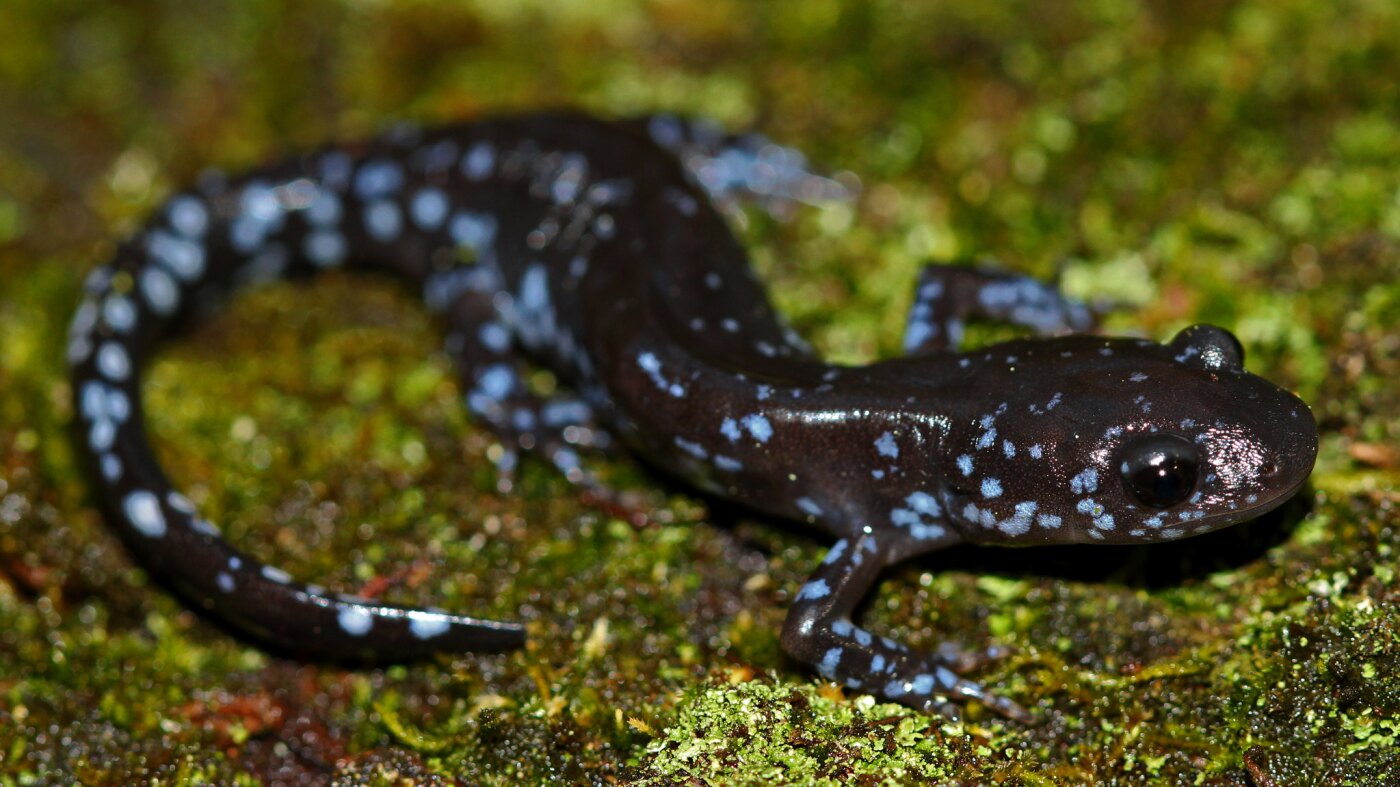
In the snow, these salamanders get supercool While blue-spotted salamanders can be sighted on warm, sunny days, they also seem to be able to venture out on cold, snowy ones, too. Peter Paplanus/Flickr CC BY 2.0 hide caption toggle caption In ancient times, people thought moist-skinned salamanders could survive in fire. That's not true, of course, but some salamanders have a surprising ability to deal with another temperature extreme: freezing cold. In fact, blue-spotted salamanders can remain active even when chilled below the normal freezing point of body fluids - a state that scientists call "supercooled." That surprised researchers who recently saw these amphibians out and about at Bat Lake in Canada's Algonquin Provincial Park in late winter. "We noticed that okay, there's still ice on the ground, the lake's still frozen, but for some weird reason, there were blue-spotted salamanders on land," recalls Danilo Giacometti , a researcher who is now at the University of São Paulo in Brazil. These salamanders live up to their name, with black bodies sporting shimmery blue spots. Besides Canada, they're found in the northern part of the United States, across the Great Lakes region and New England, up into Canada. They spend cold winters underground, but emerge from their burrows in the forests in early spring to migrate to nearby pools of water so that they can start breeding. It's been known for a while that blue-spotted salamanders can occasionally be seen walking on snow, but it was thought that this happened when temperatures had actually warmed up a bit, says biologist Glenn Tattersall of Brock University in Ontario, a member of the research team. "The presumption that we had was that maybe they were moving over snow while the temperatures are just close to freezing," he says. When they saw these salamanders out in the frigid cold, though, the researchers had a thermal camera with them. Together with another scientist named Patrick Moldowan, they took thermal images that let them measure the body temperature of the animals. What they found is that some blue-spotted salamanders actually had body temperatures below freezing, as low as 25 degrees Fahrenheit - and yet they were crawling around just fine. "If an animal was a frozen icicle it probably wouldn't be capable of movement," says Tattersall. These salamanders apparently have some kind of ability to use a natural anti-freeze that allows them to become supercooled, according to the researchers' report in the Canadian Journal of Zoology. "The really cool thing about what they saw was that they showed that there's activity in this supercooled state," says Don Larson with the University of Alaska, Fairbanks, who wasn't part of this research team. "Even though they have this very low body temperature, they're still able to do things." He says this probably helps these salamanders by letting them start their breeding as early as possible, while maybe avoiding predators that are still hunkered down. Amphibians can be surprisingly adept at dealing with frigid temperatures, he says. He's been...
Preview: ~500 words
Continue reading at Npr
Read Full Article