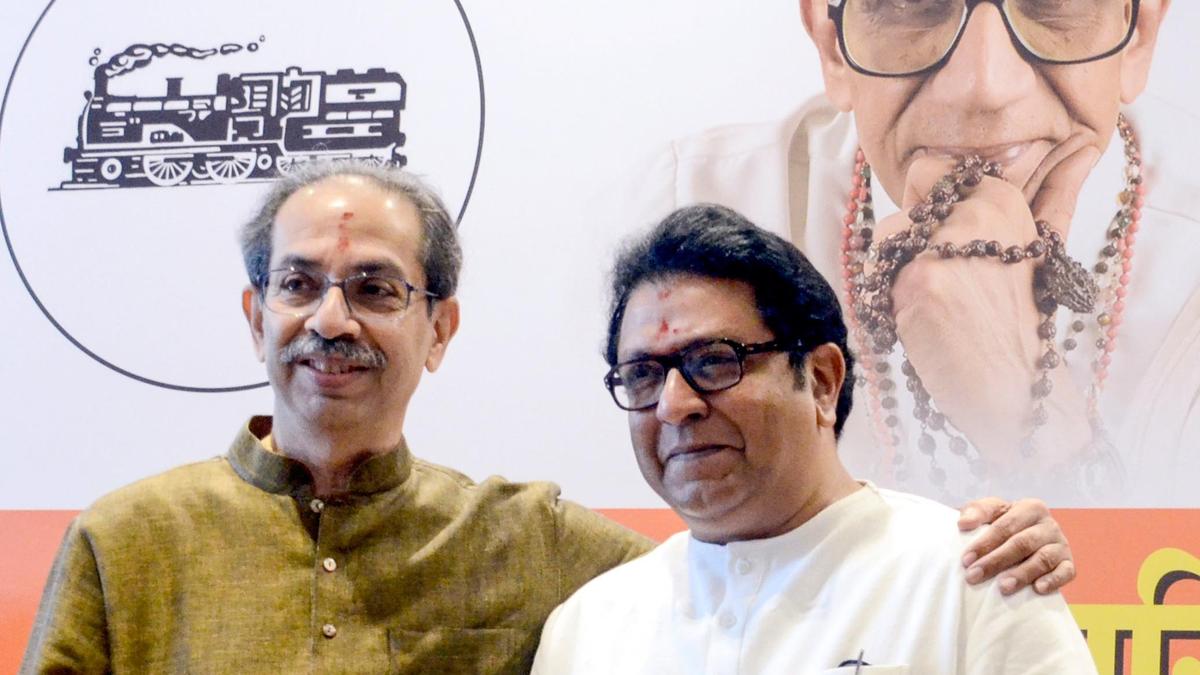
Thackerays join hands for a Mumbai that has changed beyond recognition
As Uddhav Thackeray and Raj Thackeray buried their two decades-old hatchet and announced an electoral alliance between the Shiv Sena (UBT) and the Maharashtra Navnirman Sena (MNS) for the local body polls in the State on Wednesday (December 24, 2025), they offered analogies from the Samyukta Maharashtra movement, the battle which had given birth to Shiv Sena in the 1960s on the plank of Marathi manoos (sons of the soil). Through the reunion, the Thackeray cousins are looking to capitalise on the emotive appeal of the ‘Thackeray brand’ for Marathi manoos . But will it lead to easy gains? When the Marathi manoos of Mumbai had felt disenfranchised, the struggle had led to the deaths of 106 persons who had fought for Mumbai to be included with Maharashtra. It was from the discontent and anger of the citizens seeking rights of its own city that the Shiv Sena was born in the 1960s. For decades thereafter, the Marathi manoos stood firmly with Shiv Sena founder Balasaheb Thackeray and the party to give it complete control over Brihanmumbai Municipal Corporation (BMC), which is the richest municipal corporation in the country. On Wednesday, the Thackeray cousins invoked their grandfather and social reformer ‘Prabodhankar’ Thackeray along with their respective fathers, to emphasise on the lineage of the family that had fought for the Marathi manoos , stressing on how this was under threat again. Doubling down on the ‘Thackeray brand’, the families first paid respect to Bal Thackeray at his memorial, before travelling together for the joint address. Uddhav’s wife Rashmi Thackeray and Raj’s wife Sharmila Thackeray heard in rapt attention as their respective spouses, in a brief address, formally announced the alliance without giving away any details. The differences between what was invoked and what the present situation is, are quite stark. Firstly, the demography of Mumbai has changed considerably, which does not give the Marathi-speaking population the single-handed power to elect parties. Even that vote-bank does not vote uniformly. The BJP claims to have support among the upper class Marathi-speaking population. Secondly, both Shiv Sena (UBT) and MNS have faced political debacles in recent past reducing their parties’ strength considerably. The results of the first two phases of local body elections to municipal councils and nagar panchayats in the State reflect the abysmal performance. Shiv Sena (UBT) could get only nine candidates elected as presidents in the polls to 288 local bodies, ranking fifth among the top six parties, while the MNS did not contest at all in these two phases. In 2017, when the Shiv Sena had fought the BMC elections as a united party before incumbent Deputy Chief Minister Eknath Shinde had split the party, it had garnered around 27% votes. It was the single largest party with 84 seats, while the BJP was just two short of them. But today, Shinde’s Shiv Sena has 38 of those 84 councillors in the corporation, while MNS had six councillors then. Both the cousins have so far fought for the same...
Preview: ~500 words
Continue reading at Thehindu
Read Full Article