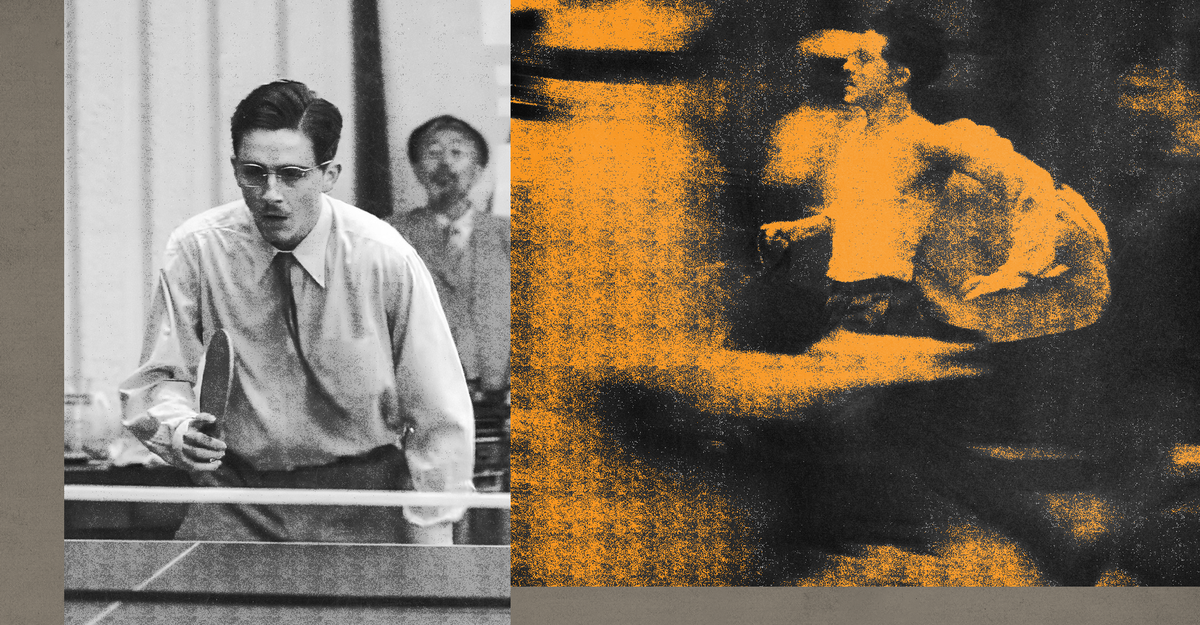
Watching Someone Fail Shouldn’t Be So Fun
Marty Mauser cannot stop the hustle. In Marty Supreme ’s electrifying opening moments, the audience is introduced to the wiry 20-something (played by Timothée Chalamet) in 1950s New York. He’s working as a shoe salesman, talking a fussy older customer into buying a fancier brand with easy confidence. Almost immediately thereafter, we learn that his boss (who happens to be his uncle) wants to make him the store manager. But Marty, a working-class Jewish kid, won’t hear of it. He has a singular career goal—to become the world’s best-known table-tennis player. His athletic ideal hasn’t exactly focused him, however: He walks right out of his uncle’s office and into a storage closet with another supposed customer—really his close friend, Rachel (Odessa A’zion)—to make passionate love. Marty is vivacious, and the film around him is buzzing at the same frequency: itchy, anxious, yet unbearably exciting throughout, each minute defined by some hairpin plot turn. Not long after that raucous first scene, he arrives in London, where he prepares to compete in a global Ping-Pong tournament while complaining about the shoddy hospitality. Like his previous movies—most of them directed in collaboration with his brother, Benny—the filmmaker Josh Safdie makes what soon becomes a high-stress journey palatable by setting off with an exhilarating level of momentum. Though the film is a hefty 150 minutes, it operates at a careening pace, barreling from twist to twist. The audience is kept handcuffed to a protagonist who’s possessed by undeniable skill and moxie, but simply can’t get out of his own way. Marty Supreme is Safdie’s first solo effort since splitting with Benny; their last work together was the fractious, nervy hit Uncut Gems . Benny also directed a sports drama this year on his own: The Smashing Machine , a much more muted effort that swerved from the Safdies’ jittery style. Marty Supreme indicates that Josh may have been the chief engineer of that approach, as evidenced by both the movie’s style and its story. The first act does the important work of establishing Marty’s desire for sports superstardom as well as his penchant for getting himself into ridiculous entanglements. The film initially seems like a familiar sports story: Loosely inspired by the real-life table-tennis player Marty Reisman, the tale follows an underdog rising through the ranks and brushing up against immortality. But Safdie, as always, seeks to challenge convention. Marty’s attempt to break out of postwar poverty, for example, feels modern; it’s even set to a pulsing soundtrack full of ’80s–New Wave hits. Read: Only Timothée Chalamet could get away with this Marty Supreme ’s ensemble is similarly colorful. During his odyssey around the world, Marty encounters an array of other frenzied creatures: There’s Milton Rockwell ( Shark Tank ’s own Kevin O’Leary), a cruel businessman who wants to bankroll Marty; Milton’s wife, Kay Stone (a magnificently frosty Gwyneth Paltrow), an actor with whom Marty pursues an affair; and Ezra Mishkin (the director Abel Ferrara), a scuzzy figure whom Marty accidentally double-crosses. He makes...
Preview: ~500 words
Continue reading at Theatlantic
Read Full Article