Scientists Discover a 23-Million-Year-Old “Arctic Rhino” in Canada
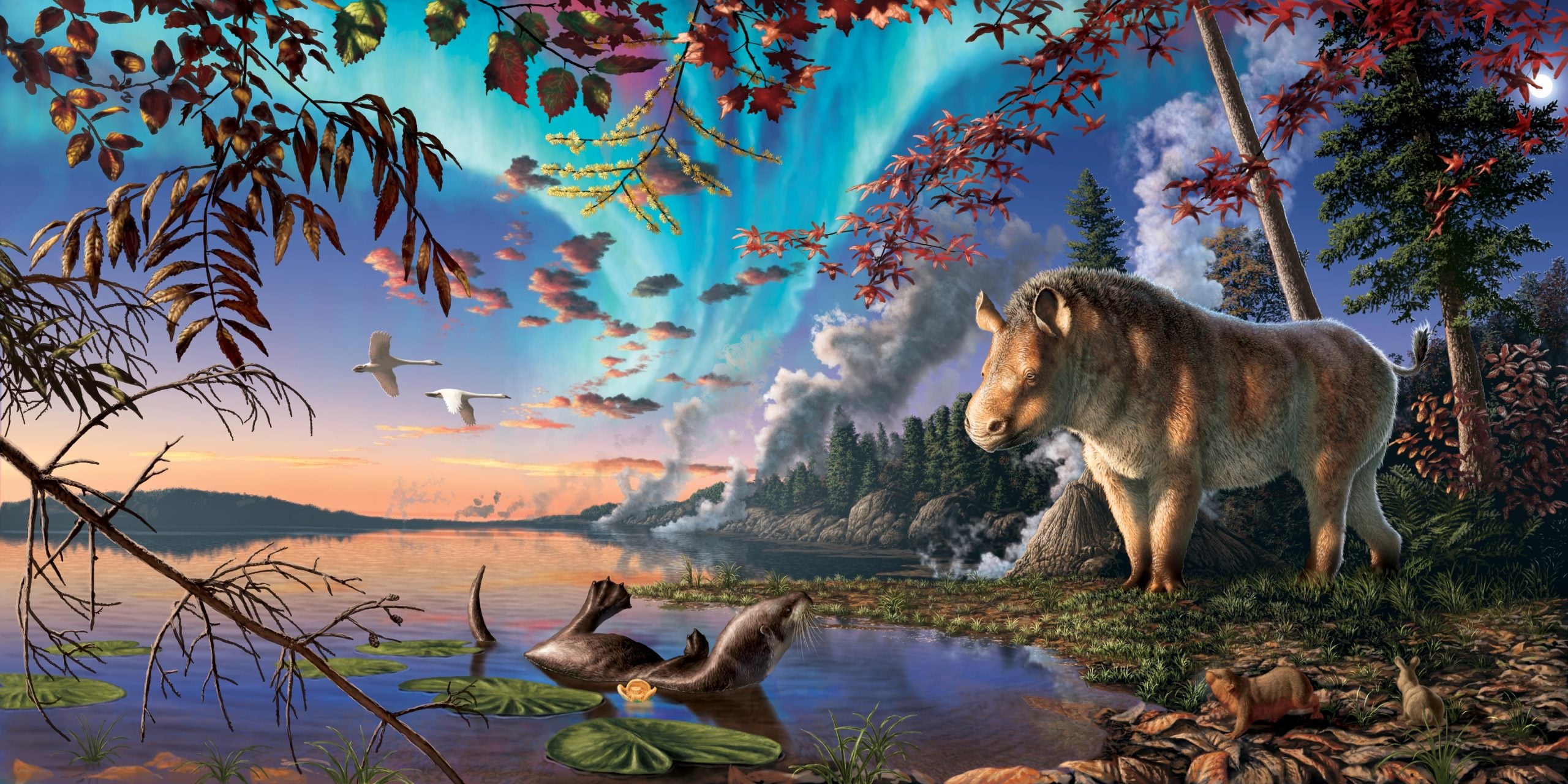
Artist’s recreation of Epiatheracerium itjilik in its forested lake habitat, Devon Island, Early Miocene, 23 million years ago. The plants and animals shown, including a rodent, rabbit, and the transitional seal Puijila darwini, are all based on fossilized remains found at the site. Credit: Julius Csotonyi Overhead view of the fossil of Epiatheracerium itjilik with its bones laid out on a sandy base. About 75% of the animal’s bones were recovered, including diagnostic parts such as the teeth, mandibles and pieces of the cranium. Credit: Pierre Poirier © Canadian Museum of Nature The Haughton Crater on Devon Island is a rich source of Early Miocene fossils, including the bones of Epiaceratherium itjilik. Credit: Martin Lipman © Canadian Museum of Nature Dr. Natalia Rybcynski (right) and Jarloo Kiguktak examine bones collected during an expedition to the Haughton Crater, 2008. Credit: Martin Lipman © Canadian Museum of Nature The museum research team (l-r, Natalia Rybczynski, Danielle Fraser and Marisa Gilbert (holding rhino jaw), examine the laid out bones of Epiaceratherium itjilik. Credit: Pierre Poirier © Canadian Museum of Nature Dr. Natalia Rybczynski (foreground, left) and Dr. Mary Dawson sift for fossils at the Haughton Crater site during a field expedition in 2007. Credit: Martin Lipman © Canadian Museum of Nature Marisa Gilbert (left) and Dr. Danielle Fraser with the fossil of Epiaceratherium itjilik laid out in the collections of the Canadian Museum of Nature. Credit: Pierre Poirier © Canadian Museum of Nature Dr. Natalia Rybczynski is a lone figure exploring the Haughton Crater site on Devon Island, where the fossil of Epiceratherium itjilik was found. Credit: Martin Lipman © Canadian Museum of Nature Museum scientists have identified and described an extinct rhinoceros species from Canada’s High Arctic. Researchers at the Canadian Museum of Nature have identified and formally described a previously unknown species of extinct rhinoceros from Canada’s High Arctic. The discovery is based on a nearly complete fossil skeleton uncovered in sediment layers from an ancient lake within Haughton Crater on Devon Island, Nunavut. This find represents the northernmost occurrence of any known rhinoceros species. Rhinoceroses have a deep evolutionary history stretching back more than 40 million years, and once lived on every continent except South America and Antarctica. This newly described “Arctic rhino” lived roughly 23 million years ago during the Early Miocene. Fossil evidence shows it was most closely related to rhino species that lived in Europe several million years earlier. The research paper detailing the new species, named Epiatheracerium itjilik [eet-jee-look], was recently published in the journal Nature Ecology and Evolution . “Today there are only five species of rhinos in Africa and Asia, but in the past they were found in Europe and North America, with more than 50 species known from the fossil record,” says the study’s lead author Dr. Danielle Fraser, head of paleobiology at the Canadian Museum of Nature (CMN). “The addition of this Arctic species to the rhino family tree now offers new insights to our understanding of their evolutionary history.” Alongside the...
Preview: ~500 words
Continue reading at Scitechdaily
Read Full Article