The myth of traditional Italian cuisine has seduced the world. The truth is very different | Alberto Grandi
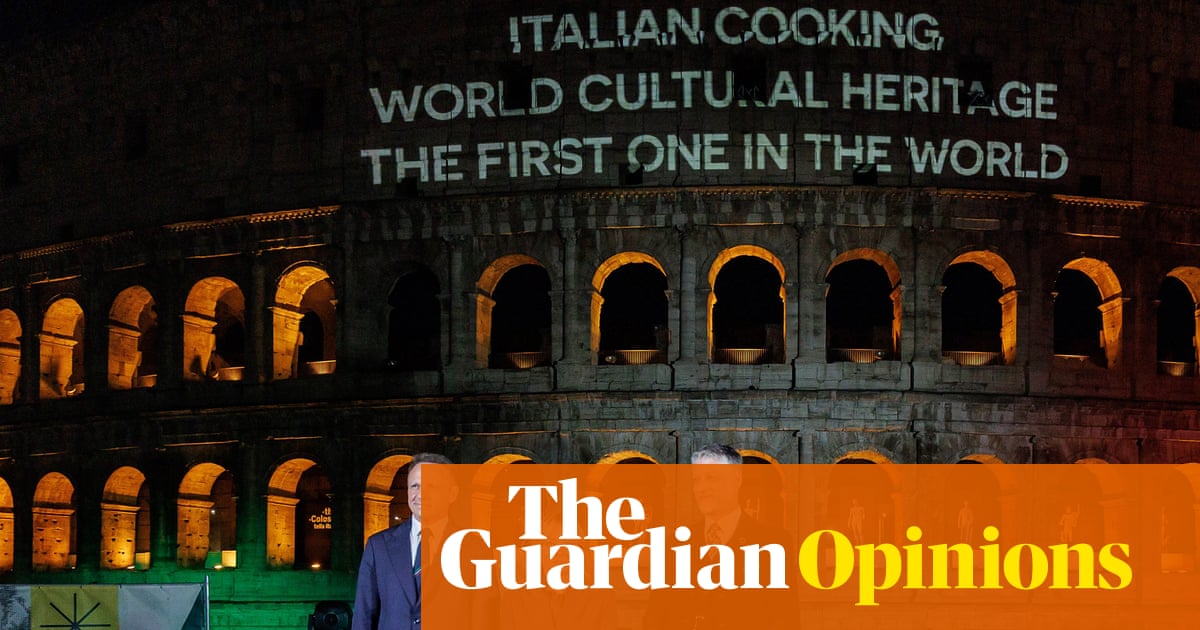
Italy’s cuisine has now joined Unesco’s “intangible” heritage list , an announcement greeted within the country with the sort of collective euphoria usually reserved for surprise World Cup runs or the resignation of an unpopular prime minister. Not because the world needed permission to enjoy pizza - it clearly didn’t - but because the news soothed a longstanding national irritation: France and Japan, recognised in 2010 and 2013, had beaten us to it. For Italy’s culinary patriots, this had become a psychological pebble in the shoe: a tiny, persistent reminder that someone else had been validated first. Giorgia Meloni, prime minister of Italy, Francesco Lollobrigida (left), minister for agriculture, and Alessandro Giuli, minister for culture, celebrate the Unesco award for Italian cuisine at the Colosseum, Rome, 10 December 2025.Photograph: Roberto Monaldo/LaPresse/Shutterstock Photograph: Getty Images/iStockphoto Yet the strength of Italian cuisine has never rested on an ancient, coherent culinary canon. Most of what passes for ancient “regional tradition” was assembled in the late 20th century, largely for tourism and domestic reassurance. The real history of Italian food is turbulent: a saga of hunger, improvisation, migration, industrialisation and sheer survival instinct. It is not a serene lineage of grandmothers, sunlit tables and recipes carved in marble. It is closer to a national long-distance sprint from starvation - not quite the imagery Italy chose to present to Unesco . To make matters worse (or better, depending on your sense of humour), the “Italian” cuisine that conquered the world was not the one Italians carried with them when they emigrated. They had no such cuisine to carry. Those who left Italy did so because they were hungry. If they’d had daily access to tortellini, lasagne and bowls of spaghetti as later imagined, they would not have boarded ships for New York, Buenos Aires or São Paulo to face discrimination, exploitation and the occasional lynching. They arrived abroad with a handful of memories and a deep desire to never eat bad polenta again. And then something miraculous happened: they encountered abundance. Meat, cheese, wheat and tomatoes in quantities unimaginable in the villages they had fled. Presented with ingredients they’d never seen together in one place, they invented new dishes. These creations - not ancient recipes - are what later returned to Italy as “tradition”. In short: Italian cuisine did not migrate. It was invented abroad by people who had finally found something to eat - a truth that fits awkwardly with Unesco’s love of millennium-old continuity. But the most decisive transformation came not abroad but at home, during Italy’s astonishing economic boom between 1955 and 1965. In that decade, the country underwent the culinary equivalent of a religious conversion. Refrigerators appeared in kitchens, supermarkets replaced corner shops, meat ceased to be a luxury. Families who had long measured cheese by the gram discovered, with a mix of disbelief and guilt, that it could be bought whenever one wished. What the world interprets as Italy’s eternal culinary self-confidence is, in reality, the afterglow of that moment....
Preview: ~500 words
Continue reading at Murmel
Read Full Article