20,00,00,00,00,00,000 Ants! How They Secretly Dominate The World By Choosing To Be Weak
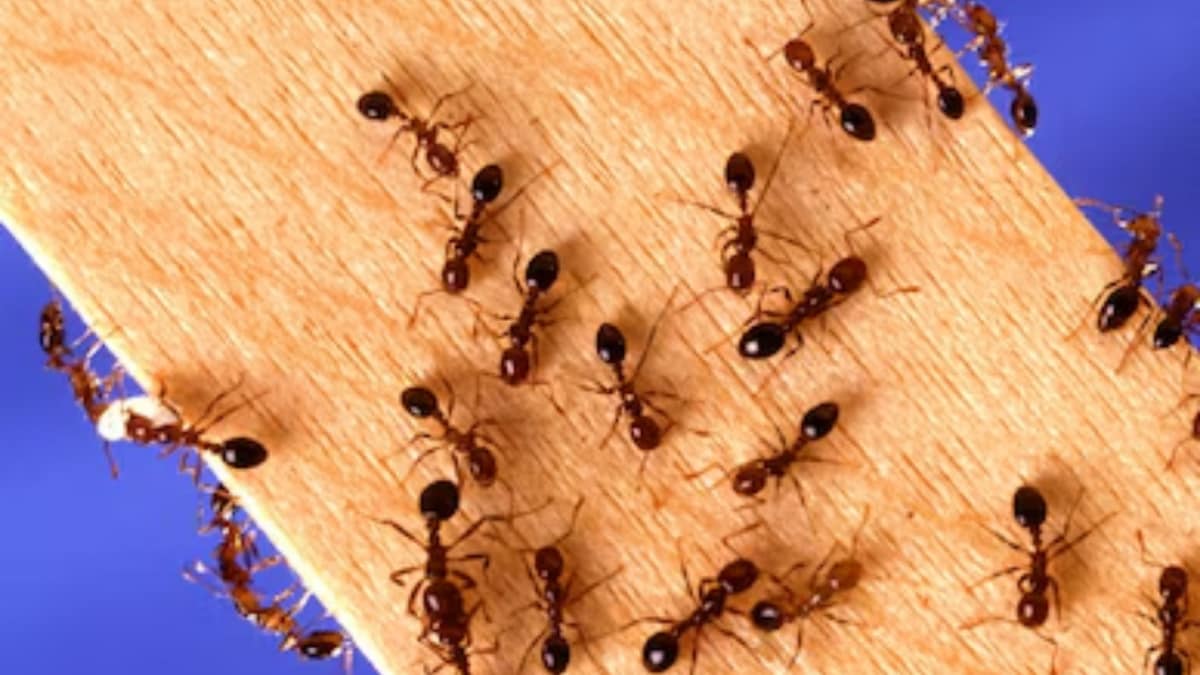
20,00,00,00,00,00,000 Ants! How They Secretly Dominate The World By Choosing To Be Weak With nearly 20 quadrillion ants on Earth, these tiny creatures seem unstoppable. A new study reveals how weakness, thin armour and sheer numbers helped ants conquer the planet Share Your Feedback + Follow usOn Google Did you know an estimated 20 quadrillion ants are living on Earth, written out as 20,000,000,000,000,000? The sheer scale of that number is staggering. What’s even more astonishing is how these tiny, seemingly fragile creatures have managed to dominate nearly every corner of the planet. A new study by researchers from the University of Maryland and Cambridge University has uncovered the secret behind ants’ evolutionary triumph. Published in Science Advances , the research reveals a surprising strategy: ants chose quantity over quality to win the evolutionary race. Recommended Stories Instead of evolving stronger individual bodies, ants evolved to produce more bodies, turning weakness at the individual level into strength at the collective level. Quality Vs Quantity You may have heard the playful question: Would you rather fight one horse-sized duck or a hundred duck-sized horses? While it sounds humorous, this dilemma captures a serious biological debate: is it better to be strong alone or weak in large numbers? Ants have answered this question decisively. They chose numbers. Why Ants Are Everywhere Rather than building large, powerful bodies, ants evolved into small, expendable workers that function as part of a massive collective. This is why ants thrive everywhere, from kitchen floors to dense rainforests like the Amazon. Their strength lies not in individual power, but in coordination and scale. The Cuticle: Armour That Came At A Cost Ants are protected by a tough outer layer known as the cuticle, which shields them from injury, disease, dehydration and predators. However, producing this armour is nutritionally expensive, requiring significant amounts of nitrogen and minerals, resources that are scarce in nature. The researchers made a striking discovery: ant species with thinner, weaker cuticles were able to produce far more workers. By saving nutrients that would have been used to build armour, these ants redirected resources towards reproduction. This trade-off allowed colonies to grow dramatically, giving them a decisive evolutionary advantage. Weak Individually, Unbeatable Together Even with weaker bodies, ants became unstoppable as groups. The research shows that in both warfare and biology, numbers often beat armour. Senior author Ivan Economo from the University of Maryland explains that as societies grow more complex, individuals tend to become simpler. Tasks once performed by one strong individual are now shared across the group, making individuals cheaper to produce but less robust on their own. Until now, this theory had never been tested extensively on social insects. Ants proved to be the perfect model, as their colonies range from just ten individuals to several million. Scanning 500 Ant Species In 3D Lead author Arthur Mat, a PhD student at Cambridge University, said the team suspected a trade-off between body protection and colony size. To test this, researchers scanned over 500...
Preview: ~500 words
Continue reading at News18
Read Full Article