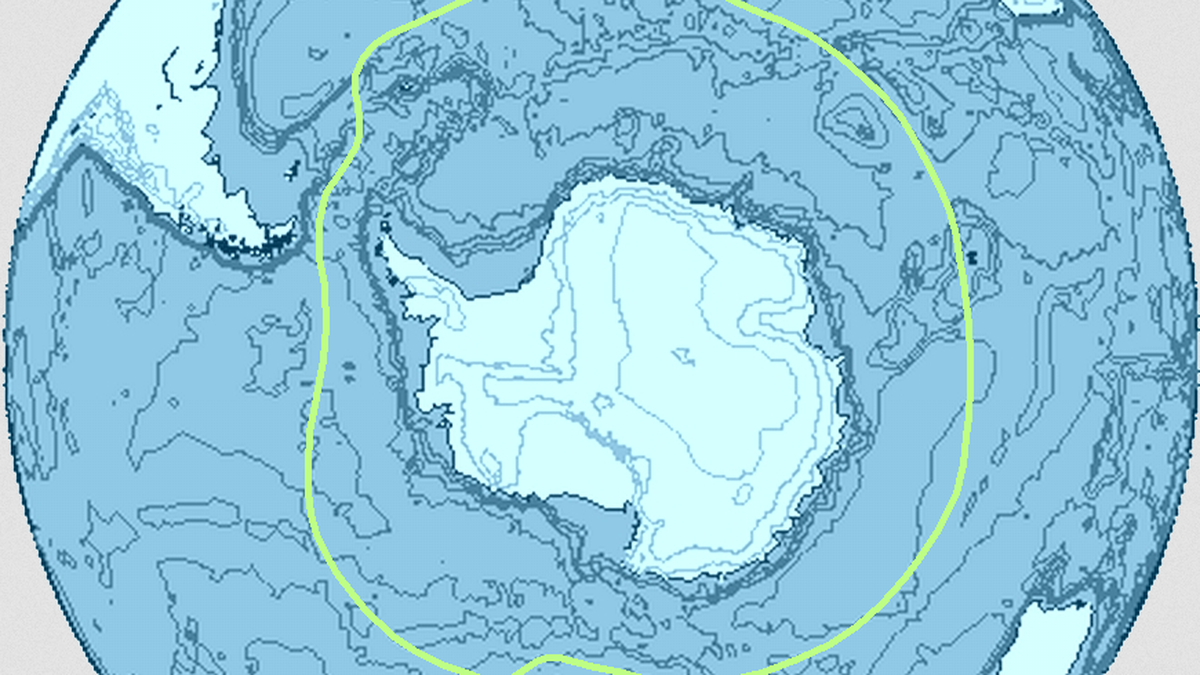
Southern Ocean carbon ‘anomaly’ reveals what models can still miss
The chilly waters of the Southern Ocean that surround Antarctica like a moat are among the least explored and least understood of all the world’s oceans. This is stark because we also know that this ocean plays an outsized role in regulating the earth’s climate with its moody currents and its tremendous ability to absorb heat and carbon dioxide from the atmosphere. The Southern Ocean covers roughly 25-30% of the global ocean area and absorbs about 40% of all the human-emitted carbon dioxide the oceans absorb. This ability of the ocean comes in large part from its cold and relatively fresh surface layers, which sit like a lid on top of the warmer, saltier, carbon-rich reservoirs. This arrangement allows the ocean to trap a lot more carbon dioxide than it emits. Even a small shift in this layering - which could be due to freshwater influx, changing wind patterns, changes in circulation, etc. - can change whether the ocean continues to act as a buffer or if it becomes a terrible new source of atmospheric carbon dioxide. For nearly two decades, scientists have used computer models to understand the ocean’s role in climate change - and the models have been saying that the Southern Ocean could become less of a sink as the world warms. Specifically, the models said stronger westerly winds and more greenhouse gases in the atmosphere would pump more carbon-rich deep water up towards the surface, which would release carbon dioxide into the air and reduce the ocean’s ability to buffer global warming. Yet new data has found the exact opposite has happened. Since the early 2000s, scientists have found the Southern Ocean to be soaking up more carbon, not less. A new long-term analysis of ocean chemistry by researchers - from the Helmholtz Centre for Polar and Marine Research and the Ludwig Maximilian University of Munich, both in Germany - has offered the clearest explanation yet for this unexpected resilience. While climate models did get important parts of the physics right, the researchers said the models missed a powerful surface process that temporarily masked the weakening they predicted. The team’s findings were published in Nature Climate Change in October. The carbon sink The models’ reasoning was physically sound, so scientists didn’t have reason to doubt them. As the concentration of greenhouse gases rose and the ozone layer thinned, westerly winds in the southern hemisphere were to strengthen and shift poleward. This shift would mean stronger upwelling in the Southern Ocean, i.e. more deep, carbon-dioxide-laden waters rising towards the surface. “The key assumption in earlier climate models is an intensification of the meridional overturning circulation of the Southern Ocean,” Léa Olivier, the new study’s coauthor and an oceanographer at the aforementioned institutions, said. “That would lead to more waters from the deep of the ocean ... being in contact with the atmosphere, and therefore weakening the Southern Ocean carbon sink.” So models predicted that as the winds got stronger, the Southern Ocean would start emitting more carbon,...
Preview: ~500 words
Continue reading at Thehindu
Read Full Article