How are we protecting astronauts from deadly space debris?
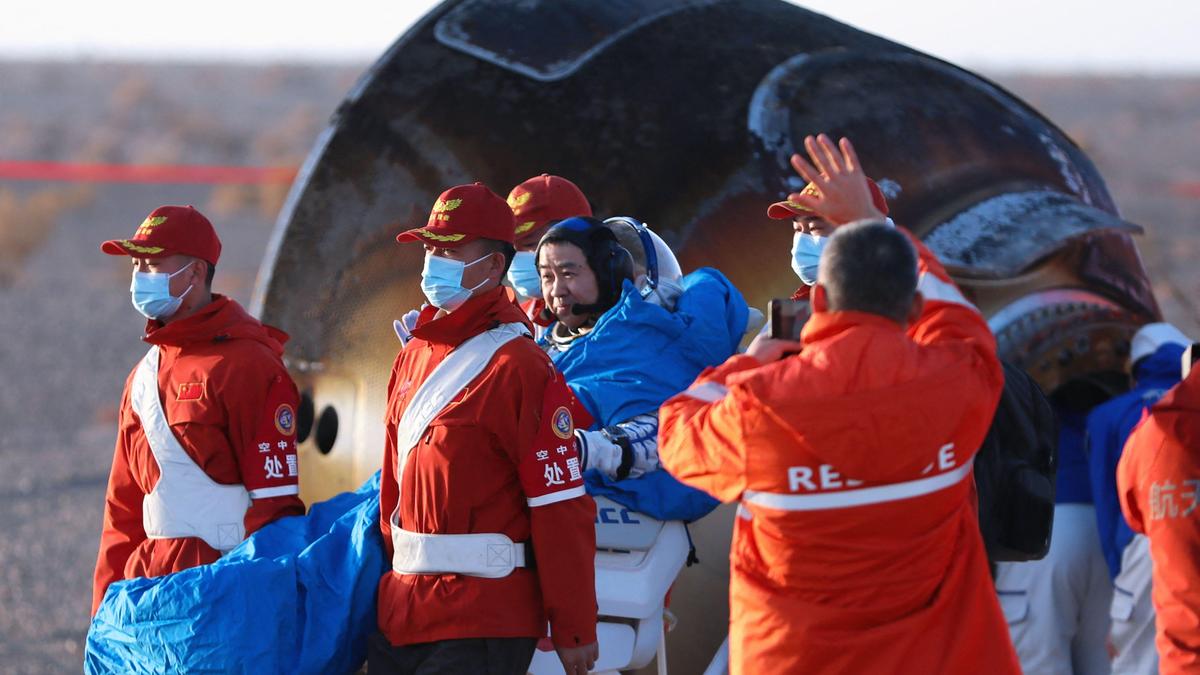
The story so far: Millions of naturally occurring Micrometeoroids and Orbital Debris (MMOD) orbit the earth, posing a constant threat to all spacecraft and space stations. The menace attracted global attention recently when a piece of debris struck the Chinese crewed vehicle Shenzhou-20, causing a minor crack in the window of its return capsule, rendering it unusable for crew travel. What is MMOD? Micrometeoroids are typically extremely small, with sizes ranging from a few micrometres (a millionth of a meter) - the approximate size of a grain of dust - to up to about two millimetres. Each weigh less than a dried grape. Most of them (about 80 to 90%) originate from collisions between asteroids in the Asteroid belt (between Mars and Jupiter) with a small portion coming from comets. They also travel at extremely high velocities (about 11 to 72 km/s). Orbital debris (also called space debris, space junk or space trash) consists of human-made objects in the Earth’s orbit that no longer serve any useful purpose. All orbital debris originated primarily from exploded rocket stages, satellites, accidental collisions and intentional anti-satellite weapon tests. The typical average speed of orbital debris is about 10 km/s. With increase in density of space debris, there could be a theoretical scenario wherein collisions between them may create a cascade of further collisions, eventually making space travel impossible, a phenomenon known as the Kessler Syndrome. The Inter-Agency Space Debris Coordination Committee (IADC) - an international forum of major space agencies such as NASA, ESA, ISRO, JAXA, etc. - plays a vital technical role by generating the foundational standards for space debris mitigation. These technical standards form the basis for the space debris mitigation guidelines adopted by the United Nations Committee on the Peaceful Uses of Outer Space (UNCOPUOS). However, the guidelines are considered as “soft law” implying that they are voluntary, and have no legally binding enforcement mechanism to compel the countries to adopt them. How is MMOD distributed in space? Orbital debris is mostly concentrated in a “shell” around the Earth in Low earth Orbit (LEO) ranging from about 200 km up to 2,000 km altitude. In contrast, micrometeoroids exist everywhere in space, but due to the Earth’s gravity pull their distribution is slightly higher near our planet. There are hundreds of millions of pieces of orbital debris in the LEO - an estimated 34,000 objects larger than 10 cm (and are accurately tracked) and over 128 million pieces greater than 1 mm in size. The micrometeoroids in Earth’s orbital environment are effectively uncountable and they deliver billions of impacts to orbiting spacecrafts annually. How are space systems designed for MMOD impact? The risk of being hit by MMOD in the LEO is not uniform; it is highly directional. The face of the spacecraft in the direction of travel experiences the maximum overall hazard because the debris collides directly with the highest relative speed. Because of the very high velocity of the debris, even tiny fragments carry enough kinetic energy to cause...
Preview: ~500 words
Continue reading at Thehindu
Read Full Article