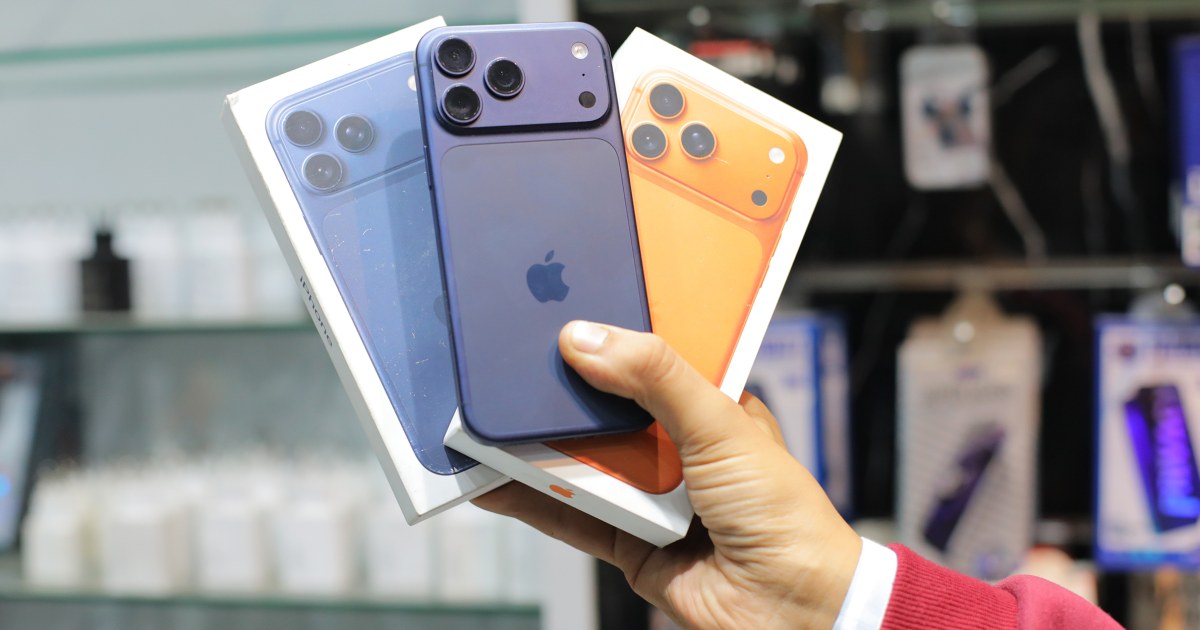
Top-end iPhones on sale in Gaza as food and medicine trickles into territory
On the side of a dusty road in Gaza , dozens of mostly young men gather against the counter of a makeshift storefront. Under a canvas roof, the acrylic display cases are filled with boxes of high-end cellphones. Customers in a crowded cellphone store.Hassan Jedi / Anadolu via Getty Images Cellphones connected to wires in mobile charging station in an abandoned Israeli tank in Gaza City.Majdi Fathi / NurPhoto via AP Trucks believed to be carrying humanitarian aid reach Gaza City earlier this month.Ahmed Jihad Ibrahim Al-arini / Anadolu via Getty Images A boy carries a meal in Deir al-Balah.Moiz Salhi / Anadolu via Getty Images It is a surreal spectacle: Palestinians, many displaced from their bombed-out homes, malnourished, sick and jobless in this collapsed economy, being sold the recently released iPhone 17 Pro . Even budget phones have been selling for as much as 5,000 shekels - around $1,500 - according to customers in Gaza, where prices have spiked to 10 times those in other countries. That such luxury items are in supply, but often food or medicine are still scarce, is exasperating aid workers and Palestinians. Experts interviewed for this story said Israel’s border controls often make commercial goods easier to transport than humanitarian aid . Though the flow has increased during the shaky ceasefire between Israel and Hamas , the United Nations and other groups say they are still facing serious restrictions on urgent items. “We cannot even afford food - how are we supposed to afford phones?” asked Samir Kamal Awad Abou Dakaa, 52, who was a construction worker before the war and has a wife and five children to feed. His family lives in a tent encampment in the southern city of Khan Younis, where his kids are given Arabic lessons using a scrap of blackboard and fed rice at a local soup kitchen. His faded blue track jacket, thinning hair and quiet voice betray what he calls a “beyond difficult” life. This contrast is not new for Gaza, said Mona Jebril, a research fellow at England’s University of Cambridge who lived in the territory for 22 years. “Before the war and during the siege, there were mobile phones and expensive cars. But because of the extra restrictions on the borders, the massive devastation and humanitarian catastrophe, then this paradox comes to light even more.” This is the latest twist in efforts to get aid into Gaza during a patchy ceasefire between Israel and Hamas. While President Donald Trump’s peace plan appears to be holding, albeit with regular Israeli airstrikes, the crisis endures. Nearly all of the population of some 2 million has been displaced, 80% of the buildings have been destroyed or damaged, and 9,000 children were hospitalized for malnutrition in October alone, according to the U.N. The ceasefire has changed things. Some 65,000 pallets of aid came into Gaza during the first month of the ceasefire, the U.N. said, double the previous four weeks. But essential equipment, such as forklift trucks and mobile...
Preview: ~500 words
Continue reading at Nbcnews
Read Full Article