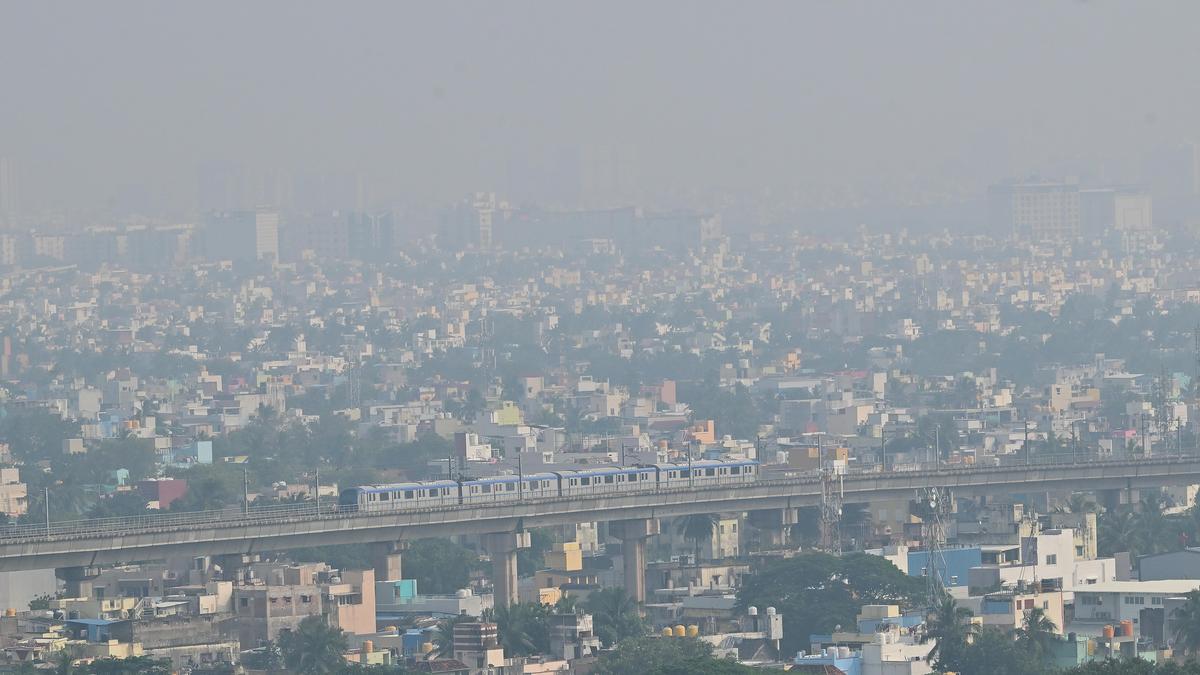
Chennai records lower PM2.5 levels, but dust pollution remains a challenge, finds report
Chennai has emerged as one of India’s better-performing cities on fine particulate pollution, even as dust-related pollution continues to pose a challenge, according to a new assessment by the Health Effects Institute (HEI) on changes in urban air quality since the launch of the National Clean Air Programme (NCAP). Analysing real-time air quality data from 2017 to 2024, the report found at least one monitoring station in Chennai, Kodungaiyur, recorded the lowest annual average PM 2.5 level in the country in 2024, at 12.6 micrograms per cubic metre, well below the national standard of 40 μg/m3. Several other locations in the city also reported PM 2.5 levels below 20 μg/m3. However, the picture is less encouraging when it comes to PM 10 , which denote the coarser particles largely linked to road dust, construction activity and soil re-suspension. Across the country, more than 90% of monitoring stations breached the PM 10 standard in 2024. Chennai was no exception, though some neighbourhoods performed notably better than most. The Velachery residential area, for instance, recorded an annual PM 10 average of 47 μg/m3, placing it among a small number of locations nationwide that met the standard of 60 μg/m3. The Delhi-NCR region continues to dominate the list of the most polluted locations for both PM 10 and PM 2.5 , with annual PM 10 levels crossing 250 μg/m3 at multiple stations. Cities such as Patna, Ghaziabad and parts of Punjab and Haryana also reported persistently high pollution levels. Coastal cities like Chennai and Mumbai, by comparison, showed lower PM 2.5 concentrations - a pattern the report links partly to meteorological factors such as sea breeze. The report also cautions against relying solely on city-wide averages. Even in cities like Chennai, which have multiple monitoring stations, pollution trends can vary sharply from one neighbourhood to another. Environmental health researcher Vishvaja Sambath said that aggregated data risks obscuring local hotspots and uneven exposure. “It masks the real problem of pollution. We need to look at more granular data,” she added. Significantly, the report noted that PM 2.5 is not included in the revised NCAP target. This is a problem as there are enough evidence that prolonged exposure to fine particulate matter causes serious chronic issues, said Ms. Sambath. S. M. Shiv Nagendra of the Department of Civil Engineering, IIT Madras, said data from monitoring stations cannot be treated as representative of an entire city, as each station measures air quality only within a radius of a few hundred metres. Mr. Nagendra pointed out the Environmental Protection Agency recommends one monitoring station for every five lakh people. He also noted that monitoring stations should be strategically located to capture source-specific emissions, such as vehicular pollution in high-traffic areas and emissions specific to industrial zones. Published - December 23, 2025 05:30 am IST
Preview: ~467 words
Continue reading at Thehindu
Read Full Article