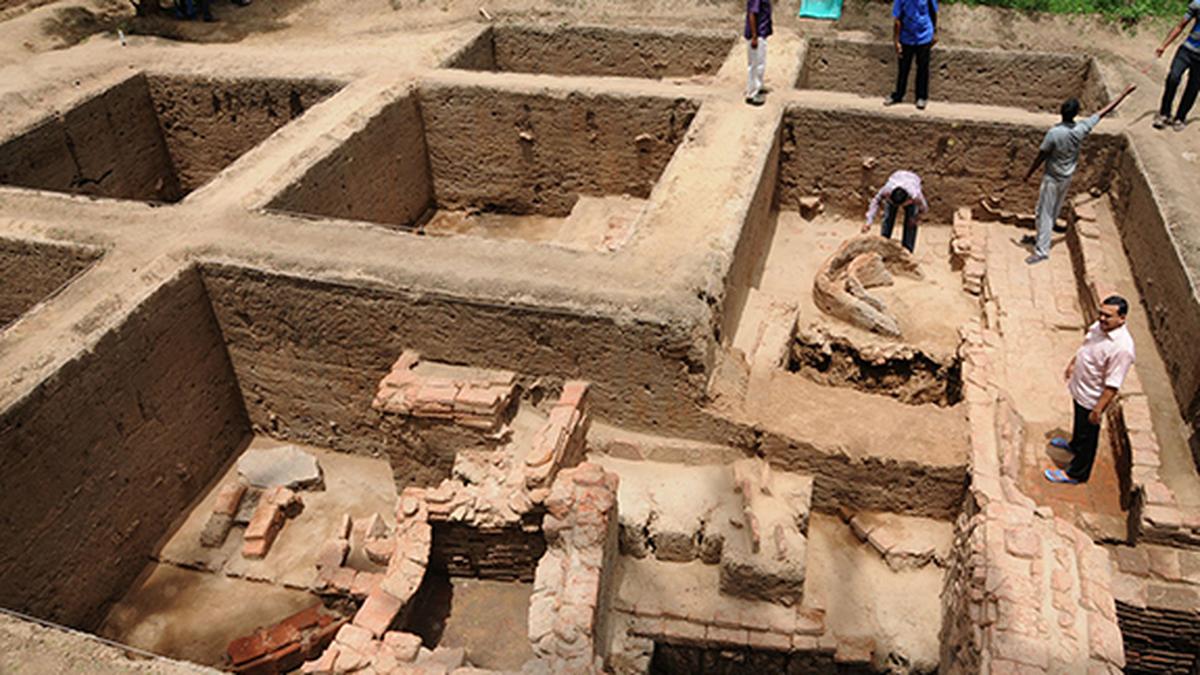
Did an ancient Vaigai flood contribute to Keezhadi’s abandonment?
Along the Vaigai river in southern Tamil Nadu, archaeologists have been excavating an old settlement at Keezhadi . They have already found brick walls, channels that look like drains or small canals, floors made of fine clay, and many pieces of pottery. These finds matter because Tamil poems from the Sangam period talk about busy towns and trade in this region but the poems don’t give firm dates. To connect the stories, the structures, and the river’s history, researchers need a reliable timeline for when different layers of sediment were laid down and when the buildings were buried. A recent study by researchers from Physical Research Laboratory in Ahmedabad and the Department of Archaeology of Tamil Nadu has now reported when flood sediments covered the Keezhadi structures. The authors focused on the fact that Keezhadi, which is in Sivaganga district, sits on a mound on the Vaigai floodplain and that the buildings are not exposed at the surface. Instead, they lie under layers of sand, silt, and clay that the river likely deposited when it flooded. If the team could date the burial sediments, they figured, they’d be able to estimate when the settlement was damaged or abandoned and then covered up. Telling time with light To do this, the team used a method called optically stimulated luminescence (OSL) dating. The basic idea is simple even if the lab work is not. Small grains of minerals, especially quartz, sit in the ground and slowly collect energy from natural radiation in the surrounding sediment. Sunlight ‘resets’ this stored energy when the grains are exposed at the surface. Later, if the grains are buried and kept away from light, they start storing energy again. In an OSL lab, scientists stimulate the grains with light and measure the glow (or luminescence) they give off. That glow helps estimate how long it has been since the grains last saw sunlight, which is usually close to the time they were buried by new sediment. The team collected four sediment samples from two excavation pits at Keezhadi, called KDI-1 and KDI-2, each from a different depth and layer. They hammered light-tight metal tubes horizontally into the sediment so that sunlight couldn’t reach the grains. In the laboratory, they opened the tubes under red light, removed the outer part that might have been exposed during collection, and kept the inner part for the actual dating measurements. Then they cleaned and separated quartz grains using chemical and magnetic methods designed to remove other minerals and contamination. The different litho-stratigraphic layers at the Keezhadi site. | Photo Credit: DOI: 10.18520/cs/v129/i8/712-718 Their measurements used a standard procedure (called the single aliquot regeneration protocol) to estimate the radiation dose stored in the quartz since it was buried. They also measured the natural radioactivity of the sediment (from the uranium, thorium, and potassium in it) to estimate the yearly dose rate the grains received in the ground. Finally, using the stored dose and the dose rate, they calculated the burial age for...
Preview: ~500 words
Continue reading at Thehindu
Read Full Article