Webb Space Telescope’s Special Aperture Turns One Sensor Into Seven
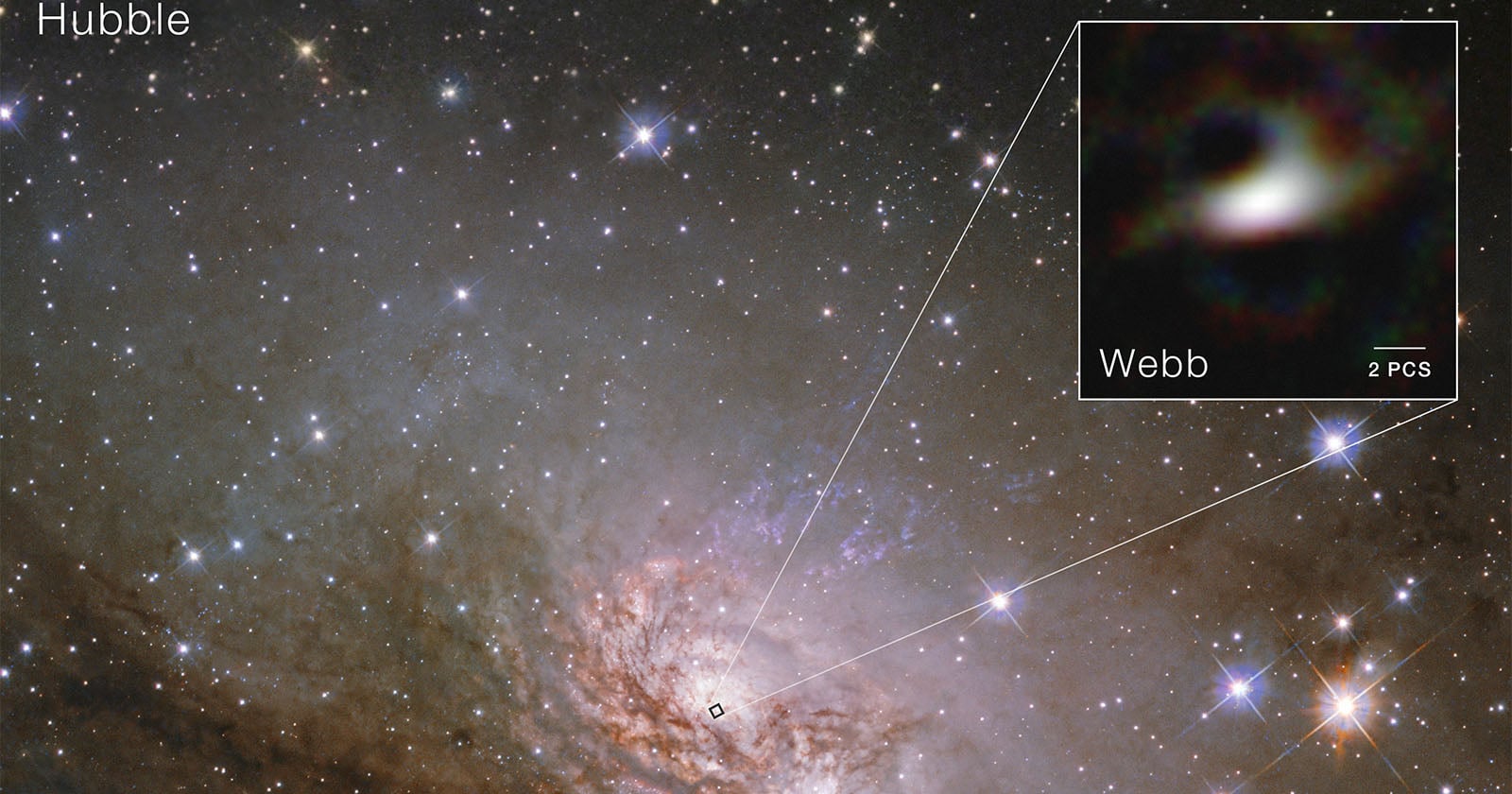
Webb Space Telescope’s Special Aperture Turns One Sensor Into Seven NASA’s James Webb Space Telescope used its sophisticated aperture mechanism to capture unprecedented images of the heart of the Circinus Galaxy, providing astronomers with data unlike anything previously obtained and completely upending the understanding of super-bright infrared regions surrounding supermassive black holes. While the James Webb Space Telescope is celebrated for its impeccable resolution across a wide wavelength range, some of its more niche, specialized imaging tools are arguably just as important for the telescope’s scientific objectives. One such tool is the Aperture Masking Interferometer on the Webb Near-Infrared Imager and Slitless Spectrograph (NIRISS). As NASA explains , interferometers on Earth typically rely on multiple telescopes, or arrays, that combine their efforts to act as a single telescope. “An interferometer does this by gathering and combining the light from whichever source it is pointed toward, causing the electromagnetic waves that make up light to ‘interfere’ with each other (hence, ‘interfere-ometer’) and creating interference patterns,” NASA explains. “These patterns can be analyzed by astronomers to reconstruct the size, shape, and features of distant objects with much greater detail than non-interferometric techniques.” What makes Webb’s approach innovative and unique is that it uses its Aperture Masking Interferometer to turn one telescope into a series of smaller telescopes that can work together to form an interferometer. Webb’s special aperture has seven small hexagonal holes, each controlling the amount and direction of light reaching the telescope’s detectors and sensors. As NASA notes, this is like an aperture on a photographic lens, albeit with seven instead of the usual one. “These holes in the mask are transformed into small collectors of light that guide the light toward the detector of the camera and create an interference pattern,” explains Joel Sanchez-Bermudez, co-author of a new research paper published today in Nature and researcher at the National University of Mexico. “By using an advanced imaging mode of the camera, we can effectively double its resolution over a smaller area of the sky,” continues Sanchez-Bermudez. “This allows us to see images twice as sharp. Instead of Webb’s 6.5-meter diameter, it’s like we are observing this region with a 13-meter space telescope.” With this aperture-based innovation, new observations delivered evidence that, contrary to belief, the largest source of infrared light near the supermassive black holes at the center of nearly all large galaxies in the Universe, is the result of an inflow of material to the supermassive black hole, not an outflow . “Supermassive black holes like those in Circinus remain active by consuming surrounding matter. Infalling gas and dust accumulates into a donut-shaped ring around the black hole, known as a torus,” NASA explains. As supermassive black holes accumulate matter, an accretion disk forms. As astronomers explain, this is like when water forms a whirlpool as it circles a drain. In the case of the cosmic whirlpool surrounding a supermassive black hole, the material moves so fast and generates enough friction that it becomes superhot and emits light....
Preview: ~500 words
Continue reading at Petapixel
Read Full Article