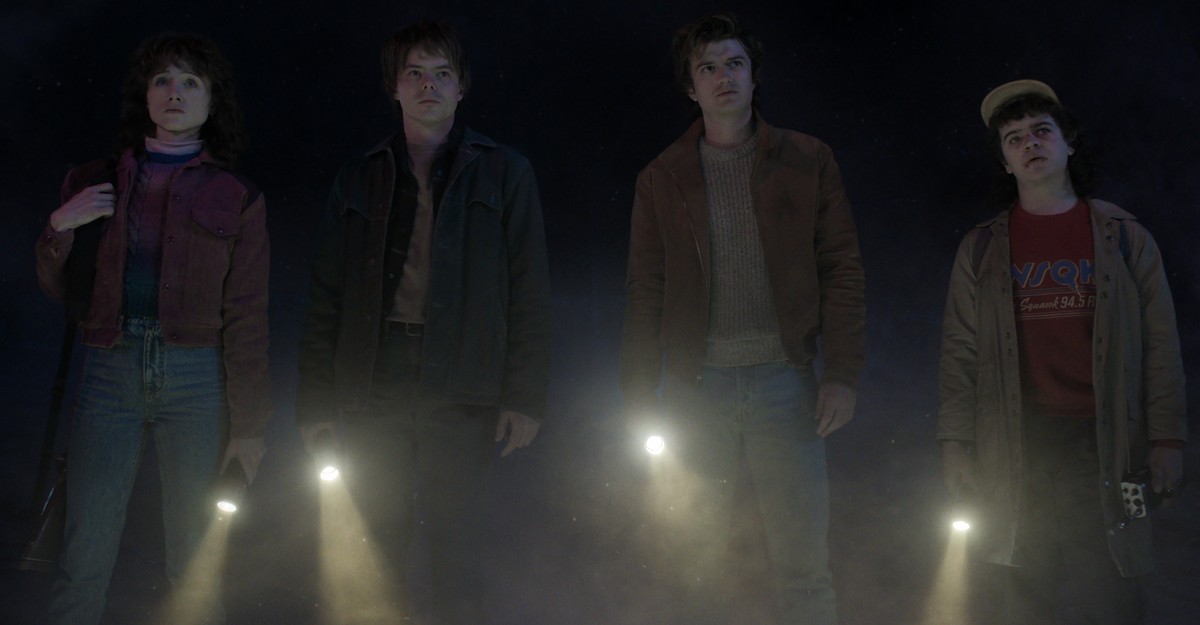
Where <em>Stranger Things</em> Lost Itself
This article contains spoilers through the penultimate episode of Stranger Things Season 5. In the third season of Stranger Things , Eleven (played by Millie Bobby Brown) learned a pivotal lesson as she stood inside Starcourt Mall , the then-new watering hole for the then-still-pubescent kids of Netflix’s supernatural drama. Eleven, the show’s telekinetic heroine, who grew up in a lab, became dazed by the number of clothing options at the Gap. “How do I know what I like?” she asked her friend Max (Sadie Sink). “You just try things on until you find something that feels like you,” Max replied. She was talking about fashion, but the advice applied just as well to the challenge of leaving adolescence behind: Coming of age is a process of trial and error, of working toward what seems true to you. For years, Stranger Things was changing too. The first season of the ’80s-set series—about underdogs triumphing over the terrors of another dimension called the Upside Down—became, after its 2016 premiere, one of Netflix’s most successful original productions. Each subsequent installment ventured into the proverbial fitting room: The second season leaned further into gore and took tonally challenging swings , including an episode exploring Eleven’s past to give its most enigmatic female character a voice. Season 3 explored how Reagan-era consumerism permeated its tweenagers’ lifestyles just as they began dealing with romantic relationships. The fourth examined conspiracy theories through a particularly unnerving, mind-manipulating villain , Vecna (Jamie Campbell Bower); he targeted a grieving Max, testing the friends’ bonds as they tried to protect her and understand her pain at the same time. In the fifth and final season , however, Stranger Things has stalled. This time around, as the gang tries to stop Vecna from ending the world, the show seems uninterested in furthering anything other than its already complicated plot. The cast has expanded several times over, to the point that most scenes look like a crowd awkwardly playing human Tetris . The action sequences resemble previous set pieces, and much of the dialogue amounts to exposition. A new, faceless threat called “exotic matter” takes the crew’s resident nerd, Dustin (Gaten Matarazzo), multiple scenes to explain. Across the three episodes of Volume 2, the last batch before the series finale, characters regularly express their confusion about what’s going on. I found myself nodding along with them. Read: Where Stranger Things loses its magic For fans watching to see how Eleven and her friends save the day, much of this stagnation is probably bearable. The show remains compulsively watchable; each episode ends on a cliff-hanger. But Stranger Things initially had much more potential than mere bingeability. It pushed the boundaries of television as a medium, eschewing standard act breaks and run-time constraints while injecting cinematic visuals and frequent mood shifts. It also cemented Netflix as an early winner of the streaming wars by consistently breaking viewership records and generating cultural conversation. A litany of brands has capitalized on the show’s popularity; it has...
Preview: ~500 words
Continue reading at Theatlantic
Read Full Article