The Stoic's Guide To Life: Ancient Wisdom For Modern Struggles
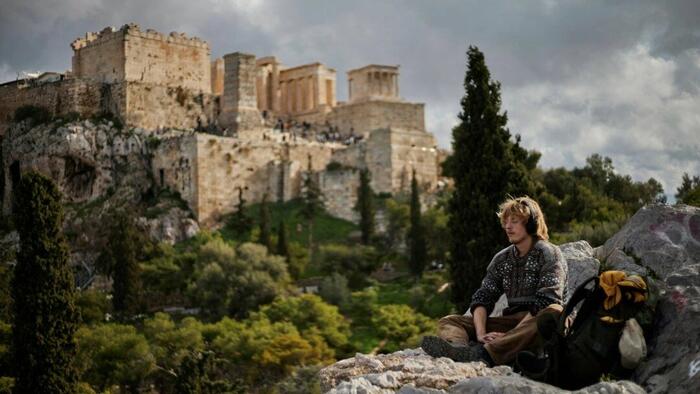
Authored by Duncan Burch via The Epoch Times (emphasis ours), A man sits on the edge of Areopagus hill opposite the ancient Acropolis hill in Athens on November 21, 2025. Aggelos NAKKAS/AFP via Getty Images Statue of Socrates at the Academy of Sciences, Humanities and Fine Arts in Athens on January 11, 2023. Photo by Martin Bertrand/Hans Lucas/AFP via Getty Images Roman emperor Marcus Aurelius (121–180) is known for his “Meditations.” Biba Kayewich Volunteers serve food during the "Turkey and Blessing" dinner at Lindale Church in Houston on Nov. 25, 2025. Ronaldo Schemidt/AFP via Getty Images Epictetus , a Greek Stoic philosopher who flourished during the early second century, said the chief task in life is to separate what is within one’s control from what is not. A man sits on the edge of Areopagus hill opposite the ancient Acropolis hill in Athens on November 21, 2025. Aggelos NAKKAS/AFP via Getty Images “ Externals are not in my power; will is in my power, ” the famed Stoic said, according to a series of teachings compiled by his student Arrian and known as “The Discourses.” “Where shall I seek the good and the bad? Within, in the things which are my own .” The philosophy of Stoicism promotes the reliance on reason and logic to determine what is good or virtuous and calls on its adherents not only to make such a determination but to act on it. Stoic ideas have had a profound effect on Western culture , including in the fields of philosophy, literature, ethics, and even mathematics, and many of the teachings remain popular today. The word “Stoic” derives from the Greek term “Stoa Poikile,” or “painted portico,” which refers to a colonnade adorned with murals depicting famous battles in the central public hub of ancient Athens. It was along this decorated colonnade that Zeno of Citium, the founder of Stoicism, walked with his students, imparting the tenets of his philosophy. Born into a merchant family during the reign of Alexander the Great, Zeno initially took up his father’s trade. However, after surviving a shipwreck, he went to Athens, where he discovered teachings by Socrates and decided to devote himself to philosophy. After studying under several prominent Athenian philosophers, Zeno opened up his own school. He taught regularly in the public marketplace for almost 40 years, until his death around 262 B.C., and his ideas became the foundation of what became known as Stoicism. Although most of the writings of Zeno and the other early Stoic philosophers did not survive, their ideas had a profound influence on the philosophical discourse of the time, in Athens and beyond. They became especially popular in the early period of the Roman Empire, where Stoic ideas were often part of the educational curriculum and espoused by prominent statesmen such as Cicero and Seneca, and even by the emperor Marcus Aurelius. Statue of Socrates at the Academy of Sciences, Humanities and Fine Arts in Athens on January 11, 2023. Photo by Martin...
Preview: ~500 words
Continue reading at Zerohedge
Read Full Article