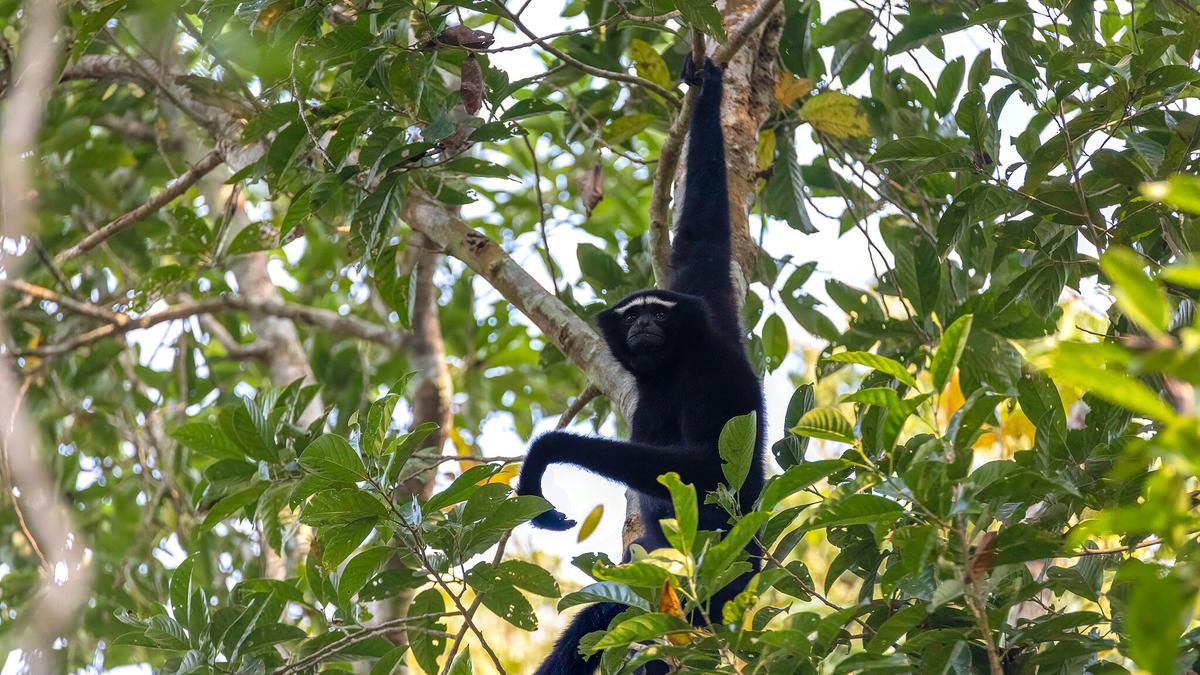
Stress tests and drones: the new playbook to protect the endangered western hoolock gibbon
In the Hollongapar Gibbon Sanctuary in Jorhat, Assam, the endangered western hoolock gibbon, the only non-human ape species in India, compete to be heard over the thundering roar of a passenger train that passes through the reserve forest. Walking through the 2,100 hectare sanctuary, visitors listen intently for the cacophonous vocalisations of the gibbon from the upper canopy while our guide points to a tall hollong tree that this forest is famous for and named after. Soon afterwards, we hear a rustle as a family of gibbons, including two offspring, swing majestically overhead. Even as we watch in awe, a faint, more threatening rumble grows louder. The gibbons scamper through the trees, and the entire forest resonates with the deafening noise of a train on the British-era Northeast Frontier Railway line that splits the forest into two unequal parts. The train typifies the multiple anthropogenic pressures, including habitat loss, fragmentation and hunting, that affects the western hoolock gibbon across its habitat in the northeast Indian states of Assam, Meghalaya, Arunachal Pradesh, Manipur, Nagaland and Mizoram. Such has been its decline over the last half a century that, according to estimates, the gibbon population has plummeted from over an estimated 100,000 individuals to less than 5,000. Rope bridges installed to facilitate gibbon passage over the Northeast Frontier Railway line. Till date, no gibbons have been recorded using them. | Photo Credit: Special Arrangement Easy target for hunters Like in most of their geographical range, the gibbon’s presence in Assam too has become severely restricted due to habitat loss and fragmentation. Additionally, threats like hunting have led to the species being listed as among the most endangered of primates in the world. The expansion of settled agriculture and deforestation too have eaten into the gibbon’s domain, say researchers. While experts believe that 9 out of 10 gibbons have disappeared over the last few decades, an exact population count has been difficult to arrive at, says Divya Vasudev, Co-Founder and Senior Scientist at Conservation Initiatives, a non-profit based in Shillong. Gibbons are also secondary targets for hunters due to their loud vocalisations that can go on for up to 30 minutes. The challenges faced by gibbons are emblematic of pressures on low-lying rainforests in Northeast India, says Rushikesh Chavan, Director of The Habitats Trust based in Noida. Chavan adds that changing land-use and jhoom cultivation are key threats to the species. “Previously, these cycles of slashing and burning would last decades, where forests would be destroyed and then allowed to regenerate. However, these cycles have now come down from decades to just 7-10 years due to pressures on the local communities themselves,” he says. Habitat loss, fragmentation and hunting are among the threats affecting the western hoolock gibbon population across its habitat in Northeast India. | Photo Credit: Getty Images Studying genetics and stress Despite challenges, initiatives are being undertaken to protect the gibbon. Udayan Borthakur, Director and Head of Wildlife Genetics Laboratory (WGL) at Aaranyak, a conservation NGO in Guwahati, says that...
Preview: ~500 words
Continue reading at Thehindu
Read Full Article