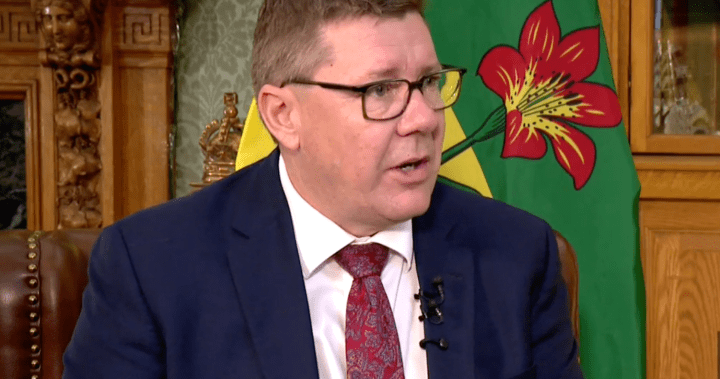
Relationship with Carney ‘much more collaborative’ than Trudeau, Moe says
Prime Minister Mark Carney stepping into office created a noticeable tone shift in provincial and federal relations, says Premier Scott Moe , adding that he has been a “much more collaborative” prime minister. The Saskatchewan premier commented on the changed dynamic in a year-end interview with Global Saskatoon’s Vanessa Tiberio, reflecting on a year marked by tariffs and trade talks for the province. “What we saw under the previous prime minister was unconsulted policies that were being imposed on industries that were creating jobs and wealth in our province,” Moe said, adding that his government often “fought back,” especially on matters concerning carbon taxation and environmental regulations. Nowadays, the challenges the country is facing align with those of the province, Moe said, with many of the tariff discussions threatening the growth of both the province and the country. Moe said Carney is working more collaboratively with the provinces to address these challenges, noting that the relationship is “much better than it was” when former prime minister Justin Trudeau was in office. Moe adds that he thinks Saskatchewan is in a “better position” than it was this time last year. Get daily National news Terms and Conditions and Privacy Policy . “It’s a different challenge, it’s a different prime minister,” Moe said. “We’re working collaboratively with him when we can. We don’t agree with everything, but we’re working with him where we can.” Moe references the recently-signed memorandum of understanding (MOU) between Alberta’s premier Danielle Smith and the federal government as an example of how Carney is working with provinces to expand both economies. Tariffs imposed by the U.S. and China dominated the conversation in the province of Saskatchewan during the past year. U.S. tariffs caused revenues from Saskatchewan’s forestry sector to fall by $121 million, while the metal industry saw a decline of $94 million. Meanwhile, China’s tariffs on agricultural and canola products cost the sector $136 million. Throughout the year, Moe maintained a steady approach to U.S. President Donald Trump’s tariff threats, often speaking out against retaliatory tariffs and making several trips south to partake in trade talks with U.S. officials. Moe maintains that his approach would look the same should tariff threats escalate next year. “We’re likely going to have to intensify the approach that we have of engaging and utilizing the contacts and the relationships that Saskatchewan has been able to build over the last decade and a half or close to two decades now to leverage getting our Canadian government to those negotiating tables,” he said. Moe also emphasizes the importance of maintaining a strong North American free trade agreement ahead of the Canada-U.S.-Mexico agreement (CUSMA) review next year. “If we are able as a continent to ensure that we have economic sovereignty, that is going to go a long way to ensuring that we’re actually able to have our general security,” said Moe, adding that the best outcome for the province would be an update and continuation of the tripartite agreement. “That’s only possible if...
Preview: ~500 words
Continue reading at Globalnews
Read Full Article