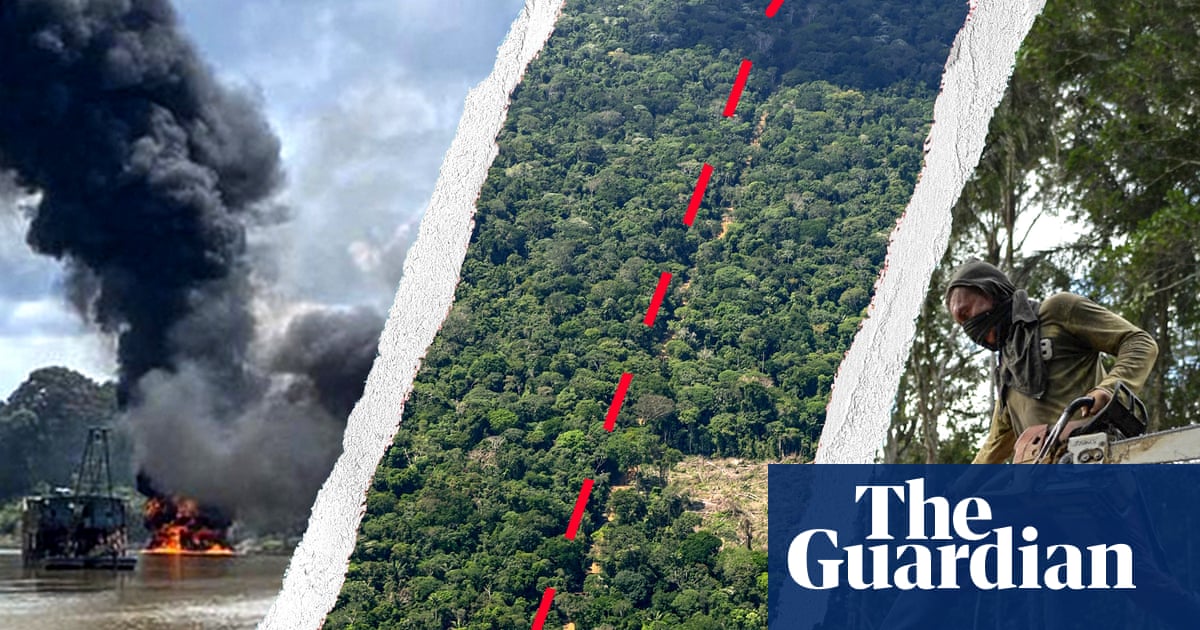
‘Cocaine, gold and meat’: how Colombia’s Amazon became big business for crime networks
High above the Colombian Amazon, Rodrigo Botero peers out of a small aircraft as the rainforest canopy unfolds below - an endless sea of green interrupted by stark, widening patches of brown. As director of the Foundation for Conservation and Sustainable Development (FCDS), he has spent years mapping the transformation of this fragile landscape from the air. Part of the network of illegal routes, centre, created by armed groups across the Amazon forest in southern Colombia.Illustration: Guardian Pictures/Alamy A route through the Amazon forest to the river. Colombia now has the highest road density in the Amazon.Photograph: Rodrigo Botero/FCDS A member of the Colombian police carries a shotgun confiscated from a suspected deforester at the Natural National Park in La Macarena.Photograph: Raúl Arboleda/AFP/Getty Images Members of the Ernesto Che Guevara front, part of the National Liberation Army guerrillas, at a camp in the Chocó jungle in 2019.Photograph: Raúl Arboleda/AFP/Getty Images The government has allocated 15,000 sq km of land to farmers and has a strategy to replace illicit crops.Photograph: Camilo Erasso/Long Visual Press/Universal Images Group/Getty Images A dredge on fire in the Amazon river at Río Puré National Natural Park in 2023 as part of a police operation to dismantle illegal gold-mining sites.Photograph: HO, Prensa Policía Nacional/AFP/Getty Images A Colombian soldier patrols near the police station attacked by Farc dissidents in Morales, in an incident that left four dead in May 2024.Photograph: Ernesto Guzmán Jr/EPA His team has logged more than 150 overflights, covering 30,000 miles (50,000km) to track deforestation advancing along the roads, illicit crops and the shifting frontiers of human settlement. “We now have the highest road density in the entire Amazon,” says Botero. Yet the infrastructure he describes is not necessarily a sign of progress or social development, but mostly a network of illegal routes expanding in southern Colombia across the Amazon forest, which covers 42% of the country . Since 2018, various armed groups have built more than 8,000km of roads there, spreading like arteries through the jungle. The layout of this new network almost exclusively benefits organised criminals, who control the vast region and use the roads to export illicit goods, which also add to the environmental devastation. “Outside Colombia , there is demand for cocaine, gold and meat; the Amazon supplies that demand. In our environmental deterioration, there is an international shared responsibility,” says Botero. In its report, Amazon in dispute , the FCDS says the north-western region of the Amazon - which has 17 illegal groups operating in nearly 70% of its municipalities - has one of the world’s highest numbers of socio-environmental conflicts . The report states: “It is a problem of macro-criminality that connects armed groups, gangs and cartels with political intermediaries and business conglomerates that, in addition to taking over natural resources and destroying ecosystems, seek to exercise territorial and population control over the region.” Another thinktank, the Ideas for Peace Foundation , also notes shifts among the factions operating in the country. “The distinction between insurgent actors and organised...
Preview: ~500 words
Continue reading at Theguardian
Read Full Article