Want to understand the sickness of Britain today? Look no further – a novel explained it all 20 years ago | Aditya Chakrabortty
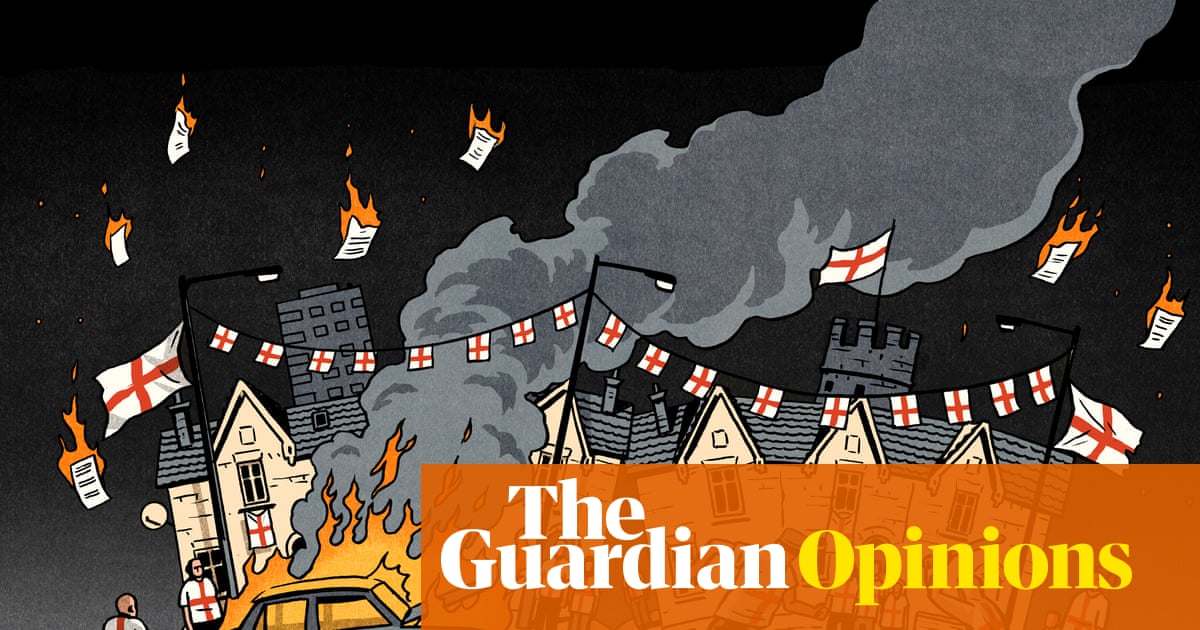
An Englishman drives into a new town and can’t see the warning signs. Richard Pearson is visiting Surrey to close down his late father’s home and settle his affairs and, everywhere he looks, the flag of St George is flying “from suburban gardens and filling stations and branch post offices”. How nice, he thinks, how festive. Soon he learns the truth. Illustration: Bill Bragg/The Guardian So runs the opening not of a recent piece of journalism, but a novel by JG Ballard , Kingdom Come, which despite being almost 20 years old anticipates today’s Britain with eerie precision. In the mid-2000s, Pearson reads up on his new surroundings, only to find the same headlines that assail us in the mid-2020s: “Every day the local newspaper reported attacks on an asylum hotel, the torching of a Bangladeshi takeaway, injuries to a Kosovan youth thrown over the fence into an industrial estate.” The crusader crosses of St George, the hair clay and bloviating of GB News and the live-streaming, selfie-gurning, hate-spewing of Tommy Robinson - their spirit is better captured in this last fiction by the late Ballard than in many more recent and more breathless titles clogging up the annual best-of lists. At the fag-end of 2025, the UK stands possibly only three-and-a-half years away from electing rightwing extremists to power, led by a man among whose sparse credentials for office are that he has never “ directly racially abused ” anyone. To explain this, analysts and campaigners often reach for stories of Russian money or US networks, or for analogies with German nazism. Such accounts emphasise how unusual and exotic such movements are in Britain, how positively foreign . The land that once boasted it couldn’t happen here can now only splutter that at least it didn’t begin here. This is bad history and worse politics. Analogies can never pass for analysis. Nor does studying the rich funders of Nigel Farage or Robinson explain their hoi polloi followers. Fittingly for a writer who titled one of his stories Myths of the Near Future, Ballard observes the country of his time to glimpse the society of our times. Everything in Kingdom Come happens in Brooklands, a suburb that wants to pretend nothing is happening. We are not in some supposedly benighted outpost of the north-east or south Wales, with cheap sentiment about the snaggletoothed “left behind”, but a junction off the M25. Rather than Epping, the centre of last summer’s protests against asylum hotels , we’re out west, among the “orbital cities of the plain, as remote as Atlantis and Samarkand to the inhabitants of Chelsea and Holland Park”. Out here are forests of business parks and convention centres, thickets of discount furniture warehouses and cheap takeaways. The great leisure activity is the gleaming giant shopping mall, which boasts “more retail space than the whole of Luton”. Amid this yawning suburbia, Pearson starts to come awake. One evening, he sees an old Volvo up in flames, and an angry mob about...
Preview: ~500 words
Continue reading at Murmel
Read Full Article