The long road to a water-secure future in Hyderabad
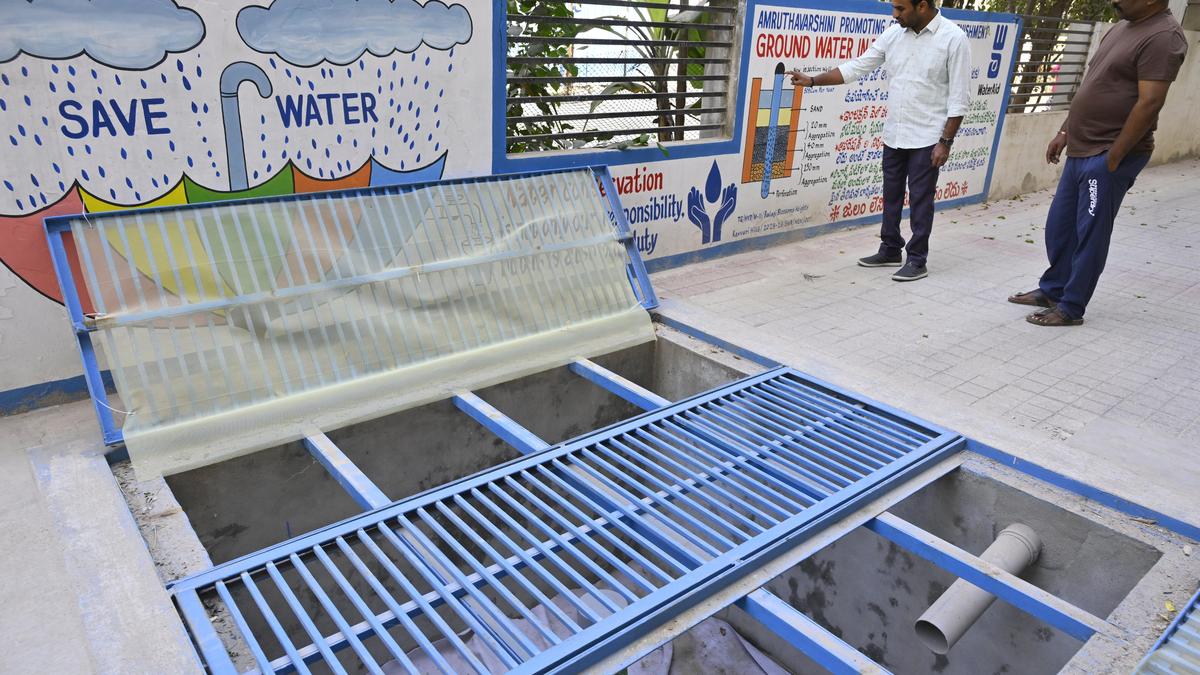
Every January, just after the Sankranthi cheer ebbs, residents of the Czech Colony in Sanathnagar, Hyderabad, brace for an annual test, watching their water taps a little more closely. The borewell serving their 40-flat apartment still runs twice a day, but not for long. Its yield starts thinning, and within a month, there is nothing left to draw. What follows is a familiar routine: they must depend on water tankers, repeatedly checking the HMWS&SB app, tracking a slow crawl up the waiting list. That ritual, however, has quietly ended. T. Srinivas, a member of the apartment association, says the turning point came with the construction of an injection borewell. The change was immediate. “Our borewell improved and a few nearby apartments that opted for percolation pits saw a difference too.” He details the consultations that went into the project, the pit collection system, annual rainwater estimates and how the intervention eased everyday life in the building. Experiences such as this are shaping a broader rethink of water use and conservation across Hyderabad. At Kavuri Hills, in the upscale Kakatiya Hills residential colony, a 16-flat apartment complex built on a 1,000-square yard plot also constructed an injection borewell with technical assistance from the Hyderabad Metropolitan Water Supply and Sewerage Board (HMWS&SB) and WaterAid, an NGO facilitating such projects through corporate social responsibility funds in select localities. Suneel, an IT professional and resident of the apartment, recalls how the building’s mandated rainwater harvesting structure was once ignored. “We were blessed with water. During monsoon, the borewell would overflow, and we would flush excess water out of the cellar through a hose,” he says. That sense of abundance, however, faded rapidly as construction activity surged in the neighbourhood. Between January and May this year, the apartment complex purchased two 10-kilolitre water tankers a day for the first time, paying about ₹1,000 per load, often with some waiting period. “We got about 100 tankers,” says Suneel, his eyebrows raised. The response came in the form of a 200-foot injection borewell. Built with a contribution of just ₹20,000 from residents, it has the capacity to harvest around 509 cubic metres, or 5.09 lakh litres, of rainwater annually. According to HMWS&SB managing director K. Ashok Reddy, building injection borewells and harvesting pits is a key focus area for the Board. He recently grabbed headlines by stating, “If every house has a rainwater harvesting (RWH) pit, the city may not even need Krishna Phase IV for the 5 tmcft additional water supply”. Yet, success stories like Czech Colony and Kavuri Hills remain exceptions in a city as large as Hyderabad. They offer a glimpse of the possibilities but do not capture the full picture. A city that cannot hold its rain Hyderabad receives an annual rainfall of 700-900 mm. But in 2025, it recorded around 1,060 mm between June and December alone, nearly 40% above normal, according to the Telangana State Development Planning Society. But the city sits on crystalline formations such as granite, gneiss and compact...
Preview: ~500 words
Continue reading at Thehindu
Read Full Article