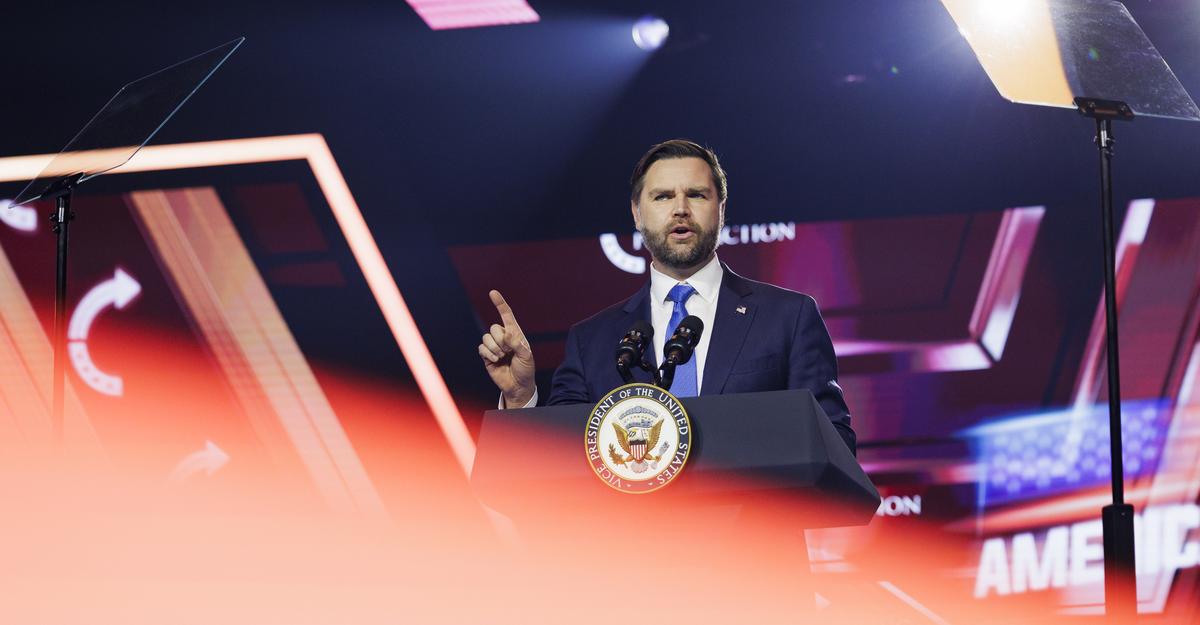
J. D. Vance Cozies Up to Anti-Semitism
On Sunday, J. D. Vance was presented with the simplest moral test: denounce commentators who traffic in medieval blood libels, who deny the Holocaust, and who endlessly harp on evil Jewish cabals. Caylo Seals / Getty The test was forced on the vice president. By the time he addressed the Turning Point USA conference this past weekend, it had turned into a referendum on latter-day Father Coughlins who have acquired substantial and growing audiences on the right. Among them is Candace Owens, whose YouTube channel has 5.7 million followers. She argues that there is a powerful, secret sect within Judaism practicing pedophilia. Meanwhile, Tucker Carlson, who has 16.8 million followers on X, has shared his microphone with an unabashed fan of Adolf Hitler and with historians who minimize the Nazi dictator’s evil. Their noxious theories about Jews became the defining question of the Turning Point confab. The podcaster Ben Shapiro denounced the anti-Semites. That prompted Steve Bannon, the former adviser to President Donald Trump, to cast Shapiro as a “cancer.” By conducting their argument in public, the two sides-those who criticize anti-Semitism and those who tolerate it-were essentially begging Vance, the headliner of the event, to render a verdict. When presented with the simplest moral test, Vance failed. “We have far more important work to do than canceling each other,” he said, as if anti-Semitism were just one more woke fixation. Strains of anti-Semitism have long festered on the American right. But in the second half of the 20th century, leaders of the Republican Party and the intellectual guardians of the conservative movement attempted to keep bigotry out of the mainstream. That’s one reason William F. Buckley Jr. used his magazine, National Review , to foil the rise of the John Birch Society in the 1960s; it’s why the GOP establishment rallied to stop Pat Buchanan’s 1992 presidential campaign-and instructed elected officials to denounce the neo-Nazi David Duke. Even in Trump’s first term as president, the party eventually stripped the Iowa congressman Steve King of his committee assignments after he defended the terms white nationalist and white supremacist . This wasn’t an unblemished record of containing far-right views, but it was an effective one. Trump has always struggled to denounce anti-Semitism, whether asked to comment on Kanye West or the tiki-torch carriers in Charlottesville. But that always seemed a product of his vanity; he couldn’t stand to speak ill of acolytes. Vance’s refusal or inability to denounce anti-Semitism is more craven-and therefore more disturbing. He’s clearly made the calculation that anti-Semites are part of the Republican Party’s base, and he can’t afford to shunt them to the side as he plots his own presidential bid. So he’s welcomed them into the mainstream of the coalition. Not that long ago, the right dabbled in imagery that reeked of anti-Semitism but refrained from fully indulging it. Populists such as Bannon railed against “globalists” and cast the financier George Soros, who is Jewish, as the shadowy force behind the demise of white Christian...
Preview: ~500 words
Continue reading at Theatlantic
Read Full Article