The Yale Review | Todd Gitlin: "In Pursuit of Clancy Sigal"
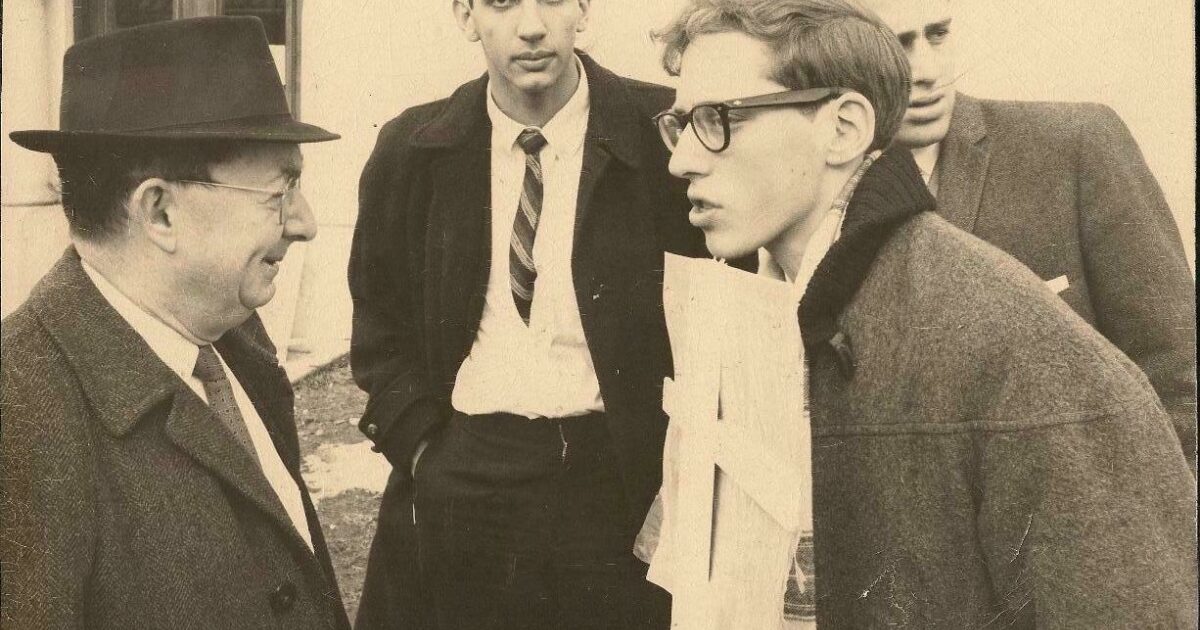
In Pursuit of Clancy Sigal A writer’s radical life Todd Gitlin, at right, speaks with the muckraking journalist I. F. Stone at a 1962 demonstration against nuclear weapons in Washington D.C. Courtesy the author. i first encountered Clancy Sigal, in a manner of speaking, in 1963, during my last semester in college. That’s when I picked up, and devoured, Doris Lessing’s novel The Golden Notebook, which featured a character named Saul Green who was widely known to have been based on Sigal. At the time, I was a fervent and brooding left-wing activist with two years of political organizing under my belt (mostly trying to ban the bomb). So I was, unsurprisingly, enthralled by Lessing’s book, which took left-wing politics and writing seriously, as human facts, not “background.” And I was mesmerized by the broken expat Green, a Communist maudit , former union organizer, blacklisted Hollywood agent, and blocked writer, attached to left-wing ideals despite reasons not to be. I was especially moved as he and Lessing’s protagonist Anna Wulf plunge into a transformative folie de deux, “a cocoon of madness.” Saul can no longer find fellowship with his old comrades, who have settled, “all married or successful and having drunken private conversations with themselves.” He won’t settle. He tosses up in London, sick and insomniac, a political refugee and scrambling neurotic. In Anna-herself a blocked novelist trying to dig out of a rubble of Communist faith, bad relationships, and war terror- he finds a kindred, equally disassembled spirit. She takes him in, impressed by “his jaunty soldier air,” coiled as he is, “his energies... absorbed in simply holding himself together,” “his cool grey eyes on guard.” But he’s also, she will conclude, a “monster,” prone to “cold moment[s] of pure hostility,” “jeering and sneering” at her “middle-class” origins. He lectures her, and she likes being lectured to. “Saul,” she says, “we’re very bad for each other.” History having abandoned them, they lurch into each other’s arms as lovers, accusers, and confessors. She, having compartmentalized her writing into topical segments, hungers for wholeness; he, stuck in a moment when “some kind of guts have gone out of people,” would “give anything to go back to when I was in the gang of idealist kids on the street corner, believing we could change everything...the only time in my life I’ve been happy.” They circle each other like ravenous carnivores biting chunks out of each other’s flesh, their cruelties spurring understandings that feel like misunderstandings. I recognized Lessing’s characters as weathered, burned-out forebears of my New Left crowd. “The truth for our time was war, the immanence of war,” writes Anna Wulf. “War was working in us all, towards fruition.” This spoke to us, given that the United States and the Soviet Union had just careened into, and almost not out of, the Cuban Missile Crisis. And my circle devoured The Golden Notebook not least because Lessing took women’s passions and quandaries seriously. Lessing named their disquiet, their longing to be “free...
Preview: ~500 words
Continue reading at Hacker News
Read Full Article