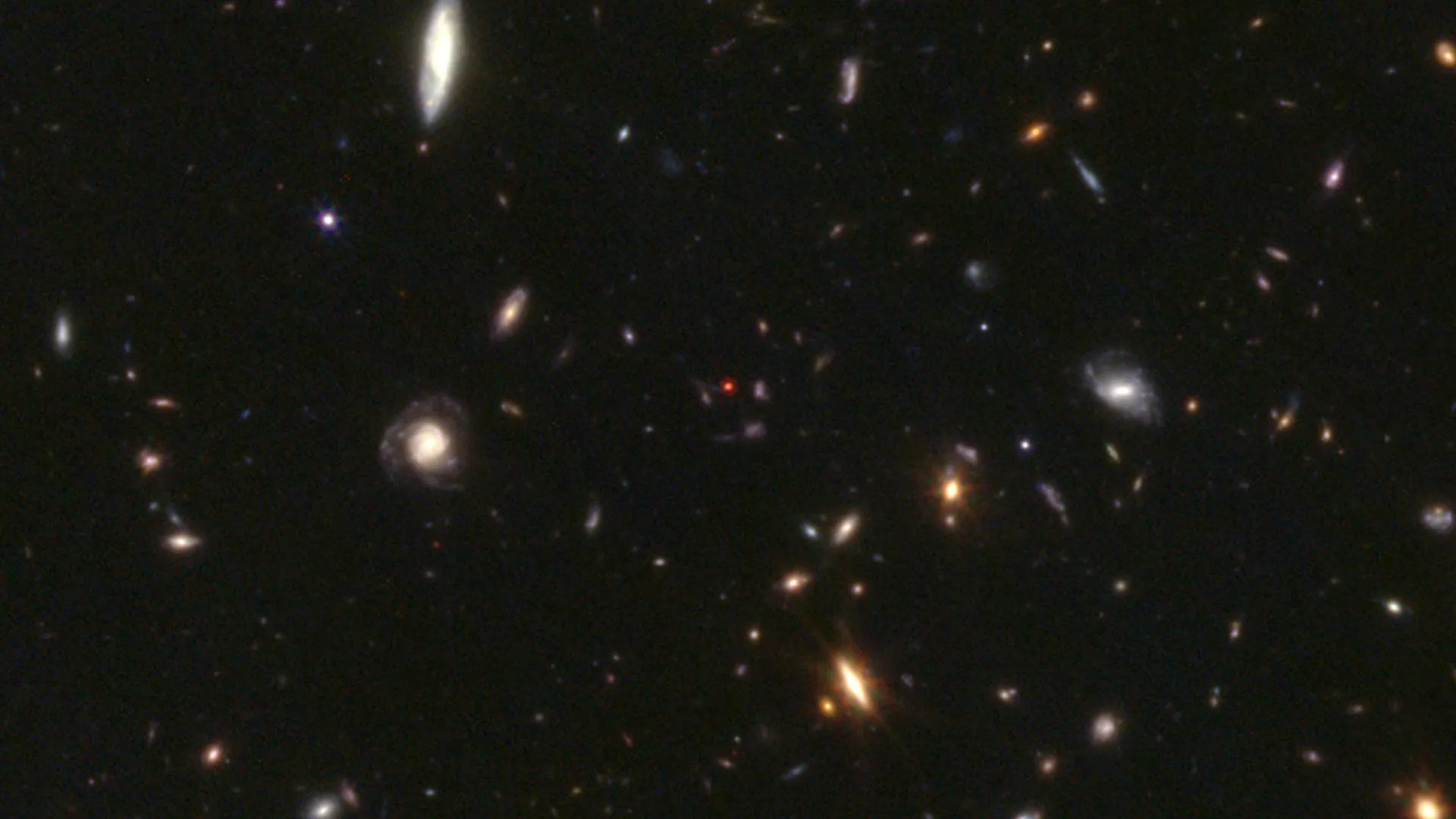
Those strange red dots in James Webb images finally have an explanation
Those strange red dots in James Webb images finally have an explanation James Webb’s mysterious red dots are newborn black holes caught in a fiery growth spurt. Date: January 16, 2026 Source: University of Copenhagen Summary: For years, strange red dots in James Webb images left scientists puzzled. New research shows they are young black holes hidden inside dense clouds of gas, glowing as they devour their surroundings. These black holes are smaller than expected but grow rapidly, shedding light on how supermassive black holes appeared so early in cosmic history. The finding reveals a violent and messy phase of the universe’s youth. Share: Since the James Webb Space Telescope (JWST) began scientific operations, astronomers have been intrigued by strange red dots appearing in its images of the distant universe. Scientists from the University of Copenhagen have now identified what these objects are, uncovering extreme cosmic activity hidden inside dense clouds of ionized gas. Their findings were published in Nature on January 14. When James Webb captured its first images in December 2021 from a distance of about 1.5 million kilometers from Earth, researchers quickly noticed something unexpected. Scattered among stars and galaxies were small, unexplained red points of light that did not fit existing models of the early universe. A Cosmic Mystery in the Early Universe These objects, nicknamed "little red dots," appear during a period when the universe was only a few hundred million years old. Roughly a billion years later, they seem to vanish from view. Their brief appearance raised a major question: what exactly were these glowing red sources? One early idea suggested they were massive galaxies bright enough to be detected across 13 billion years of cosmic history. However, that explanation conflicted with what scientists know about galaxy formation. Such large galaxies should not have existed so soon after the Big Bang, as they require much more time to develop. Black Holes Hidden in Gas Cocoons After analyzing Webb's data for two years, researchers at the Niels Bohr Institute's Cosmic Dawn Centre reached a different conclusion. The red dots are powered by black holes, the most extreme objects known in the universe. These observations offer a rare look at how the first black holes formed and began to grow. "The little red dots are young black holes, a hundred times less massive than previously believed, enshrouded in a cocoon of gas, which they are consuming in order to grow larger. This process generates enormous heat, which shines through the cocoon. This radiation through the cocoon is what gives little red dots their unique red color," says Professor Darach Watson, one of the lead authors of the study. '"They are far less massive than people previously believed, so we do not need to invoke completely new types of events to explain them." The significance of the discovery placed the Cosmic Dawn Centre team on the front page of Nature, one of the world's most influential scientific journals. Why Black Holes Are "Messy Eaters" Astronomers have now...
Preview: ~500 words
Continue reading at Sciencedaily
Read Full Article